Muskegon Short-Term Rental Rules: What Waterfront Buyers Should Know
"We could rent it out when we're not using it." If you are shopping the Muskegon waterfront, that thought has probably crossed your mind - and a listing that mentions rental income is counting on it. The part the listing leaves out: between 2024 and 2026, the local cities went three very different directions on short-term rentals. On some streets, the answer is simply no.
Last reviewed July 2026. Local short-term rental rules change quickly - verify the parcel with the city before relying on rental income.
Three cities catch most of the Muskegon-area waterfront shopping: the City of Muskegon, North Muskegon, and Norton Shores. If the plan is an Airbnb, Vrbo, or any other vacation listing, the city line matters as much as the shoreline. The short version: the same rental plan can be waitlisted in one city, prohibited outright in the second, and newly licensed in the third at the steepest fee of the three. The rules below are current as of mid-2026, with sources linked at the bottom. While researching this page, one city's rules changed completely inside five months - verify before you commit money to any of it.
Never Buy the Rental Income With the House
In the City of Muskegon, a short-term rental license is non-transferable, per the city's own applicant statement. The Airbnb history that helps sell the house does not automatically convey to you at closing - and in capped neighborhoods there may be no new license to get. If the numbers only work with rental income, verify the license situation for that exact parcel first.
Three Cities, Three Different Answers
| City | Can You Short-Term Rent? | Key Limits |
|---|---|---|
| City of Muskegon | Yes, with a license - but capped by zone, and the waterfront zone is full | $500/year registration; 11-zone overlay district with Beachwood/Bluffton listed as waitlist-only; license status transfers only for pre-March 2024 rentals |
| North Muskegon | Prohibited in most residential areas | Banned in the district covering nearly all waterfront streets; special approval elsewhere, 7-day minimum, 4 months/year max |
| Norton Shores | Yes, with registration - a new program as of spring 2026 | $2,000 registration fee; $2,000,000 liability insurance; 24/7 local agent for distant owners; a 500-foot spacing rule in the ordinance as introduced |
City of Muskegon: Licensed, Capped, and Non-Transferable
The City of Muskegon runs a formal short-term rental program. The city's zoning ordinance defines a short-term rental as a property leased without a host on premises for more than 24 hours but less than 28 days. Host-occupied rentals are not STRs, but they still must register. Per the city's rental program page, registration is a recurring annual fee - $500 per year for a single-family home, scaling up to $2,500 for a quinplex - renewed each spring.
The city's short-term rental guide adds the operating requirements: general liability coverage plus at least $10,000 in dwelling fire insurance. Owners who live outside Muskegon County must also name a local agent available 24 hours a day, 7 days a week to field complaints. Enforcement is a ladder: a $250 civil infraction for the first violation, $500 for the second, and $1,000 plus license revocation for up to a year on the third.
Then came the cap. In late 2024, after a temporary ban on new short-term rentals, the city adopted what is now the Short-Term Rental Overlay District: 11 zones, each allowing a limited number of licensed short-term rentals. For anyone shopping near the water, one detail towers over the rest: as of mid-2026, the city lists Zone 1 - Beachwood/Bluffton, the strip between Muskegon Lake and Lake Michigan - as full, waitlist only. The other ten zones are open.
When the ordinance passed, local news reported Beachwood/Bluffton at 73 existing short-term rentals against a cap allowing 39. In the one zone waterfront buyers care about most, a new license is not a form you file; it is a spot on a waitlist.
And the license itself does not follow the house. The city's applicant statement is explicit: "a short-term rental license is non-transferable and non-assignable." The one exception, per the city's rental program page: properties with an active short-term rental status before March 2024 are eligible for a one-time status transfer, in any zone, with a signed formal document. Even then, only the status transfers - the new owner still completes their own registration and inspections.
The safe assumption for a buyer is still the conservative one: the seller's rental history is theirs, not yours, until the city says otherwise in writing.
North Muskegon: Prohibited on Most Waterfront Streets
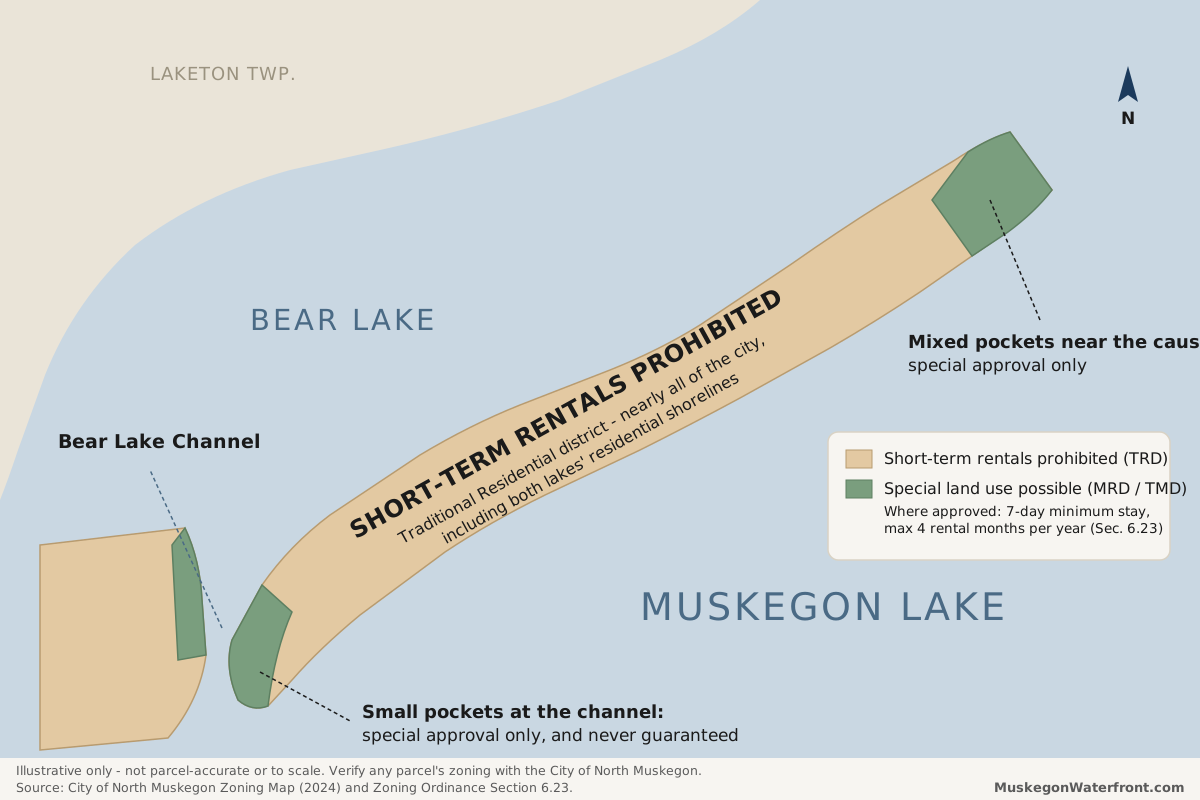
North Muskegon took the most restrictive path of the three, and it did it through zoning. Section 6.23 of the city's zoning ordinance allows short-term rentals only as a special land use - meaning case-by-case Planning Commission approval - and only within the Mixed Residential and Traditional Mixed-Use zone districts. In the Traditional Residential district, short-term rentals are not a permitted use at all.
On the water, that zoning choice decides everything: the city's 2024 zoning map shows the Traditional Residential district covering nearly the entire peninsula. That includes essentially all of the residential shoreline, on both the Muskegon Lake side and the Bear Lake side.
The Mixed Residential pockets where a short-term rental is even possible sit mostly at the northeast end of the city near the causeway. If you are picturing a lakefront house on a quiet North Muskegon street with an Airbnb calendar attached, the zoning says no in almost every case.
Even where a special land use is granted, the ordinance keeps it modest:
- Minimum stay of seven days
- No more than four months of rental use in any calendar year
- Maximum of three occupants per bedroom
- A 25 percent cap on units within a multi-unit building
- A named local representative and a city business license
A seven-day minimum with a four-month annual ceiling is not the weekend-rental model. It is closer to the old-fashioned summer cottage lease, which is a reasonable read of what the city intends to allow.
Two locally useful footnotes. First, on the zoning map, the few waterfront-adjacent parcels outside the Traditional Residential district cluster around the Bear Lake channel and the causeway end of the city. So if you ever hear about a legal short-term rental near the water in North Muskegon, that is roughly where it would have to be - by special approval, not on a regular residential street.
Second, while the zoning rules are North Muskegon's own law, the city contracts rental property inspection and code enforcement to Muskegon Charter Township, per the city's Inspection Department page. That is useful to know when you are trying to confirm a specific property's rental status by phone.
Norton Shores: A Brand-New Ordinance With a $2,000 Price Tag
Norton Shores got here last, and the path shows how fast these rules can change. On January 20, 2026, the city council unanimously declined to introduce a short-term rental ordinance. Four weeks later, on February 17, the council introduced and approved a revised version, 6 to 1. It amends the zoning code to add Section 48-1163, "Short-Term Rentals," with changes to a 500-foot spacing requirement and stiffer penalty language including license revocation.
It went on the March 3, 2026 council agenda for adoption, and the city's Building Division now publishes the registration form. If you had checked the rules in January and bought in June, you would have bought into a different regulatory world.
The program itself, per the city's current registration form, requires:
- A $2,000 registration fee
- Proof of at least $2,000,000 in commercial liability insurance for the rental address
- A parking site plan
- Registration with the county Convention and Visitors Bureau for the accommodations tax
- A completed property checklist before inspections are scheduled
- For owners more than 60 miles outside the city: a property manager or local agent available 24/7 who holds a key
For scale, that registration fee is four times the City of Muskegon's single-family rate. Between the fee, the insurance, and the spacing rule, this is a program built for serious operators.
Because the ordinance is this new, confirm the current details with the Building Division at (231) 799-6801 before you count on a license for a Mona Lake or Lake Michigan shoreline property. Ask specifically about the final spacing rules, renewal terms, and how the 500-foot measurement treats water frontage.
What About Month-to-Month or Annual Rentals?
A natural worry after reading the above: if short-term rentals are banned or capped, does that catch a month-to-month lease, a seasonal rental, or a year lease? No - all three cities draw the line explicitly.
North Muskegon's ordinance says that if a tenant leases a dwelling for at least one calendar month, "this is not a short-term rental, but is instead a residential use." So the prohibition on North Muskegon's residential streets does not touch a monthly, seasonal-by-the-month, or annual lease, waterfront included.
In the City of Muskegon the line is 28 days: rent for 28 days or longer and you are an ordinary rental, with no STR license, zone, or waitlist involved. Norton Shores draws its line at 30 days, with a frequency trigger: its rental-property article defines "short-term vacation housing" as a dwelling renting for periods under 30 days more than three times per year. Anything longer, or less frequent, is a regular rental.
Even ordinary rentals come with rules. The City of Muskegon requires all rental units - long-term leases included - to be registered and inspected, with a recurring annual fee; that is what its Rental Property Program covers beyond the short-term rules. In North Muskegon, rental inspections run through the city's contract with Muskegon Charter Township.
Norton Shores requires annual registration of every rental dwelling and a certificate of compliance before occupancy, good for up to three years. Distant owners there need a local agent within 30 miles, and a new owner has 30 days after taking ownership to register. One detail worth checking before closing rather than after: the city will not issue that certificate until every outstanding city charge on the property is paid in full. That means property taxes, special assessments, water and sewer bills, even lawn-mowing charges.
The paperwork is real, but for a buyer whose plan is "rent it by the year until we're ready to move in," none of the caps, waitlists, or zoning bans on this page stand in the way. And for an owner weighing the opposite move, the guide to selling a Muskegon waterfront home covers what buyers will ask - including about the rental history.
Short-Term Rental Taxes Apply Everywhere
Whichever city the parcel sits in, two tax layers cover short stays county-wide. Michigan charges a 6 percent use tax on accommodations of less than one month, which the big platforms collect automatically. Muskegon County adds its own 5 percent accommodations tax on stays of 30 nights or shorter.
Watch the fine print on that one: per the county's guidance, even when a platform collects the local tax from the guest, it pays the money to the owner. The owner is still responsible for reporting and remitting it to the county, monthly or quarterly, through the LocalGov system. Unaware owners are common enough that the county says it has hired help finding non-filers.
Factor both layers, plus the non-principal-residence property tax rate, into any income math; the property tax comparison covers that last piece.
Before You Buy: The Short-Term Rental Checklist
- Pull the parcel's zoning first. In North Muskegon especially, the district decides the question before any license does.
- Ask the city, in writing, whether a new license is available for that address - in a capped City of Muskegon neighborhood, it may not be.
- Assume the seller's license dies at closing unless the city confirms a transfer path for that specific property.
- In a condo, read the HOA documents before anything else. An association can prohibit or restrict rentals regardless of what the city allows; the condo buyer checklist covers which documents to demand.
- Budget both tax layers (6% state use tax, 5% county accommodations tax) and the non-homestead millage rate.
- If your plan is monthly or annual instead, relax - the short-term caps and bans do not apply, though regular rental registration and inspection still do.
- Re-verify everything close to closing. Every rule on this page changed at least once between 2024 and 2026.
Rental rules are one example of a bigger pattern: the facts that decide whether a waterfront purchase works are often not on the listing sheet. For the rest of that pattern - high water, erosion, dock limits, condo building risks, and the municipal costs nobody has billed yet - read the waterfront flooding and hidden risks guide.
Common Questions
Can you run an Airbnb in North Muskegon?
In most of the city, no. North Muskegon's zoning ordinance (Section 6.23) prohibits short-term rentals in the Traditional Residential district. The city's 2024 zoning map shows that district covering nearly all of the residential shoreline on both Muskegon Lake and Bear Lake. In the smaller Mixed Residential and Traditional Mixed-Use pockets, a short-term rental requires Planning Commission approval as a special land use, with a seven-day minimum stay and a four-month-per-year cap. Verify the specific parcel's zoning with the city before assuming anything.
Do City of Muskegon short-term rental licenses transfer when you buy the house?
As a rule, no. The city's applicant statement says the license is non-transferable and non-assignable. The city's rental program page describes one exception: a property that already held active short-term rental status before March 2024 can pass that status once to a buyer, whatever the zone, through a signed formal document. What moves is the status alone; registration and inspections start over with the new owner. If a listing touts rental income, verify that property's status and the transfer paperwork with the city before you count on a dollar of it.
How many short-term rentals does the City of Muskegon allow?
The city caps licensed short-term rentals through a Short-Term Rental Overlay District divided into 11 zones, each allowing a limited number. In mid-2026 the city's list showed ten zones open and one closed: Zone 1, the Beachwood/Bluffton waterfront running between Muskegon Lake and Lake Michigan, stood at full with a waitlist. When the cap ordinance passed in late 2024, local news put the count in Beachwood/Bluffton at 73 existing rentals, and the cap allowed 39 - hence the waitlist. Confirm current zone availability with the city.
Does Norton Shores have a short-term rental ordinance?
For practical purposes, yes - and it is brand new. After unanimously declining to introduce an ordinance on January 20, 2026, the council introduced a revised version on February 17, 2026, adding Section 48-1163, Short-Term Rentals, to the zoning code (approved 6 to 1). It was placed on the March 3, 2026 agenda for adoption. The city's Building Division now publishes a registration form requiring a $2,000 fee, proof of $2,000,000 in commercial liability insurance, a parking plan, county CVB registration, and a 24/7 local agent for owners more than 60 miles away. Confirm the current ordinance text with the Building Division at (231) 799-6801.
What taxes do short-term rentals pay in Muskegon County?
Two layers county-wide. The state's 6 percent use tax applies to stays under a month and typically gets collected by the platform. The county then layers its own 5 percent accommodations tax onto any stay of 30 nights or less. The owner is responsible for reporting and paying the county tax (monthly or quarterly through the county's LocalGov system) even when a platform collects it from the guest.
Do the short-term rental bans stop month-to-month or annual rentals?
No. North Muskegon's ordinance says a lease of at least one calendar month is a residential use, not a short-term rental. Monthly, seasonal, and annual leases are fine even on streets where short-term rentals are prohibited. In the City of Muskegon, rentals of 28 days or longer are ordinary rentals with no STR license, zone, or waitlist. The city does still require all rental units, long-term included, to be registered and inspected with an annual fee. Norton Shores sets its boundary at 30 days with a frequency trigger: under 30 days, more than three times a year, is short-term vacation housing. Regular rentals there need annual registration plus a certificate of compliance.
Sources
- City of Muskegon Rental Property Program - the current STR definition, overlay district zones and availability, annual fee schedule, and the one-time transfer policy (reviewed July 2026)
- City of Muskegon Guide to Short-Term Rentals (February 2024) - insurance, local-agent rule, enforcement, and the non-transferable license statement
- City of North Muskegon Zoning Ordinance, Appendix A - Section 6.23 (short-term rentals) and Table 6.02.A (district use table), reviewed July 2026
- City of North Muskegon Zoning Map (2024) - district boundaries referenced for the shoreline description
- City of North Muskegon Inspection Department - the contracted rental-inspection arrangement with Muskegon Charter Township
- Norton Shores Short-Term Rental Registration Form and Checklist - the $2,000 fee, insurance, agent, and CVB requirements (posted spring 2026; linked from the city's Building Division page)
- Norton Shores council packet, February 3, 2026 - the January 20 minutes recording the first ordinance's unanimous denial - and the March 3, 2026 packet - the February 17 minutes recording the revised Section 48-1163 introduction (6-1) and the adoption agenda item. (As of July 2026, Municode's Norton Shores code still lists Sections 48-1163 through 48-1176 as reserved - the new ordinance had not yet been codified there.)
- Norton Shores Code of Ordinances, Chapter 8, Article VI "Rental Property" - annual rental registration, the certificate of compliance, the 30-mile agent rule, and the 30-day short-term boundary (Ord. No. 786 of 2016, as amended; reviewed July 2026)
- Visit Muskegon: Short-Term Rentals in Muskegon County - the 5% county accommodations tax and 6% state use tax
- WOOD TV8 and WZZM 13 - reporting on the City of Muskegon cap ordinance and neighborhood counts
Related Guides
Waterfront Flooding and Hidden Risks
High water, erosion, dock limits, and the other facts a listing will not volunteer.
Read the guideProperty Tax Comparison by Area
Millage, taxable value, and the non-homestead rate that applies to a rental property.
Compare areasSelling a Waterfront Home
The mirror view: what buyers will ask about your rental history, permits, and price.
Read the seller guide