Adelaide Pointe: New Marina, Mass-Timber Condos, and Big Plans on Muskegon Lake
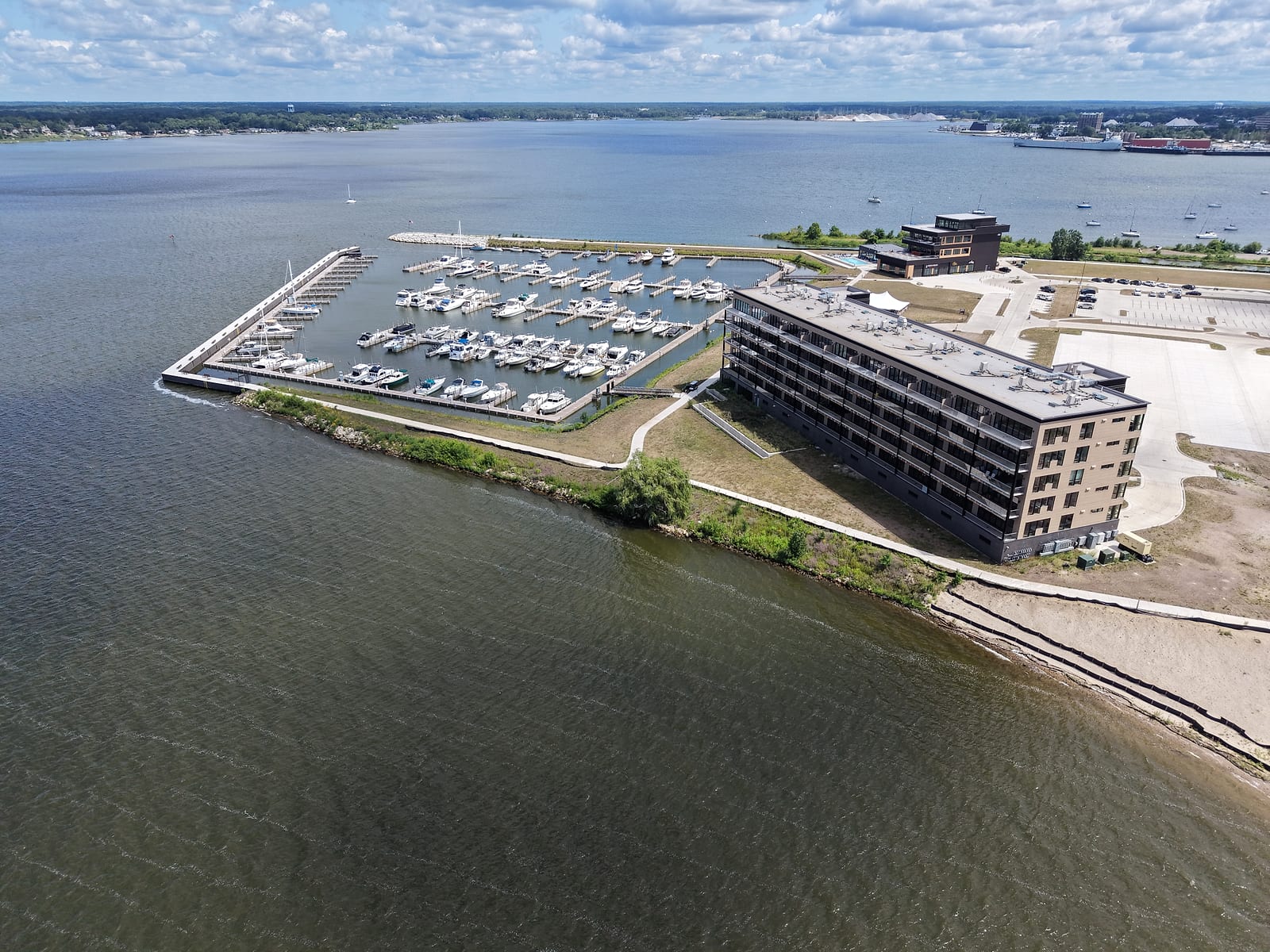
Adelaide Pointe is the 35-acre mixed-use development at the west end of West Western Avenue, on the south shore of Muskegon Lake, built where a lumber mill and then a foundry worked the shoreline for over a century. Today it holds a marina of more than 160 wet slips, climate-controlled dry-rack storage, a six-story mass-timber condominium building, Muskegon Brewing Company, an event center, and a rerouted stretch of the public Lakeshore Trail. It is also, as of this writing in October 2026, a project whose developer companies are reorganizing in Chapter 11 bankruptcy while its marina and restaurant keep running - a fact the marketing does not advertise. Where it sits among the area's other condo communities is mapped in the waterfront condos guide.
Last reviewed October 2026. This is a project in motion - the status section below is dated, so check for newer news before acting on it.
Quick Facts
- Location
- 400 Adelaide Circle, west end of W. Western Ave
- Site
- 35 acres of former lumber-mill and foundry land
- Wet slips
- More than 160; the published counts vary
- Condo building
- Six stories, mass timber, 55 units (34 unsold and unfinished as of October 2026, per the developer's own filing)
- Also on site
- Restaurant, event center, dry-rack storage, trail and pier
- Status
- Operating; five developer companies in Chapter 11 since April 2026; the restaurant and event-center building's owner filed its own case in September 2026
A Century of Industry First
The development's own history page tells the early story: a lumber mill stood here from the 1870s, shipping timber off two docks that ran nearly 1,200 feet out into Muskegon Lake - the largest on the lake at the time. The remnants of those docks became the two peninsulas that now flank the marina basin. In the early 1920s, Michigan Steel Company set up foundry operations on the property, a business that later carried the name Westran Foundry, and the casting furnaces ran until 2007. Decades of foundry sand and industrial fill pushed the shoreline farther into the lake, which is part of how a 35-acre parcel came to exist here at all.
The property's exit from industry ran through a local name first. Westran Corp. sold 1204 West Western to Kirksey Investment Corp. in September 2005 - the city's published timeline of the site records the sale - and in the years after, the old buildings did quiet duty as boat storage. I can add a line of my own to that chapter: I kept my boat in that dry storage, in the years when this address was simply where boats waited out the winter. In March 2021 the property changed hands again. Adelaide Pointe QOZB LLC, the development entity of Ryan and Emily Leestma - the same couple who bought North Muskegon's Bear Lake Tavern in 2022 - purchased the parcels from Kirksey Investment Corp. and Shipyard Properties LLC for a reported $5.5 million.
The City of Muskegon's brownfield plan shows the first phase, revitalizing those same storage buildings, underway by the spring and summer of 2021. The 2022 version of the plan lays out the full five-phase vision: the building work first, then the wet marina with its mixed-use and boater-services buildings, then a 55-unit condominium building, then a hotel with more boat storage, then additional condominiums, all anticipated to finish by 2030. The first three phases exist. The hotel and the later condominium phases were plans on paper as of 2022; verify what actually stands today before assuming the rest.
Anyone who watched this lakefront through its industrial decades will recognize what a change that is. The wider arc - sawmills to foundries to cleanup to the current wave of building - is the subject of this site's Muskegon waterfront transformation guide; Adelaide Pointe is that story compressed into one parcel.
The Marina
Start with the numbers, which do not quite agree. The marina's boat-slips page advertises 169 slips, including 33 transient; its development-plan page describes 163 reserved slips plus 33 transient; Marinas.com lists 161. Rather than pick a winner, call it what every version agrees on: a marina of more than 160 wet slips with dedicated transient dockage. Slip lengths run 40 to 70 feet, aimed at boats and yachts in the 40-to-80-foot range, and that upper end is the point - the lake's other marinas generally top out around 60-to-70-foot slips. While this one was still under construction, trade coverage quoted the developer saying dedicated slips for 80-footers and up would put Muskegon on the map for the biggest boats on the lakes.
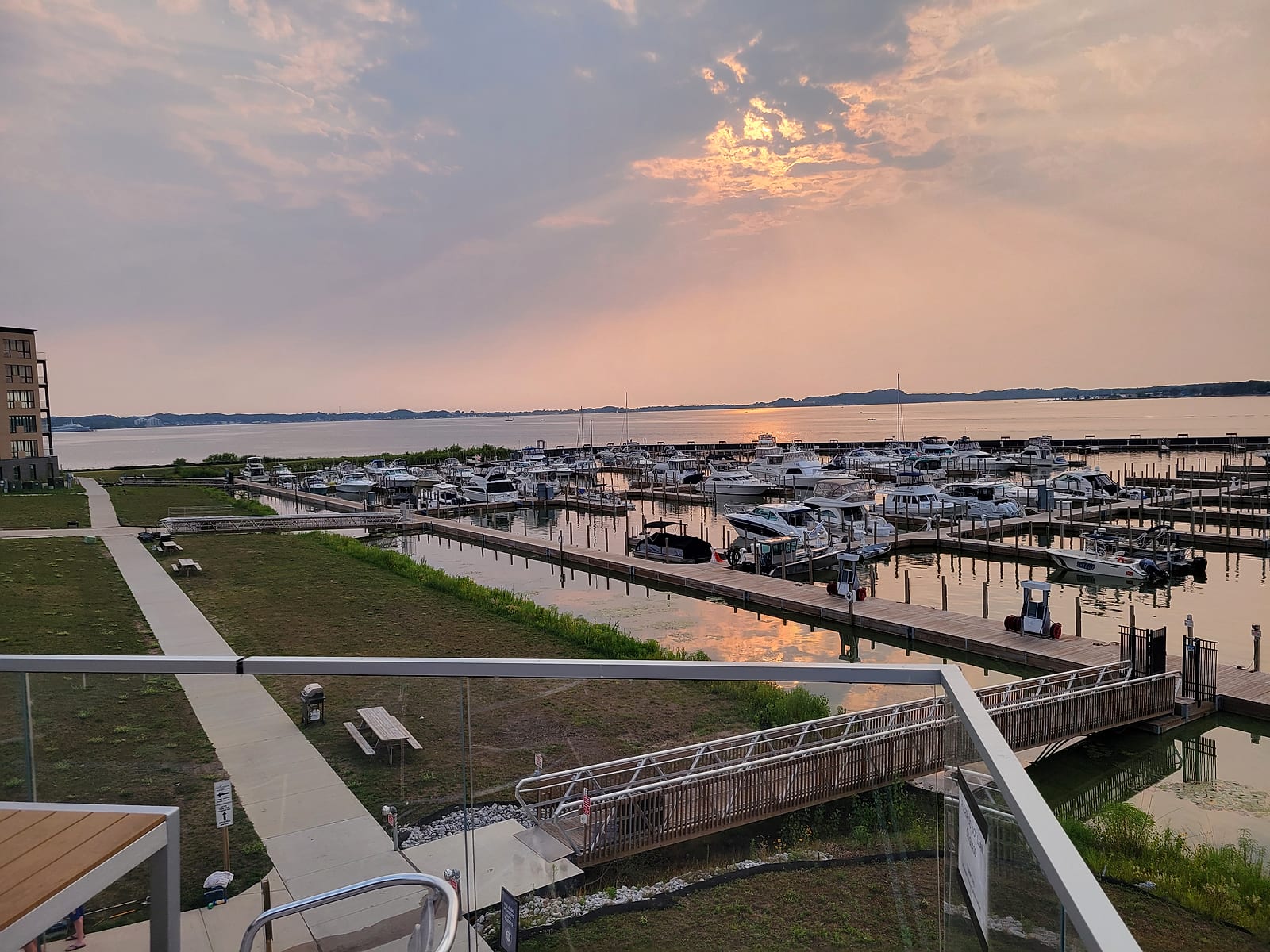
The hardware backs the ambition: 30-, 50-, or 100-amp power at the pedestal, municipal water, mesh Wi-Fi, and wood floating docks, with transient reservations handled through Dockwa. The marina held its grand opening in May 2024, which makes it West Michigan's newest, and the operator advertises it as the first new marina built anywhere in Michigan in nearly 30 years.
The boater-services building is the amenity core: a captain's lounge, showers, laundry, and restrooms, a pool and hot tub with a grilling patio, a ship store, and a staffed dockmaster's office, with fuel and pump-out available dockside and an on-site office of the Muskegon County Sheriff's marine division, which the operator says runs two patrol vessels out of the marina. For winter, the dry-rack facility is climate controlled - the marina's pitch is that boats stored there skip winterization entirely - with published rack lengths of 19 to 42 feet, and the service department advertises mechanical, engine, and electrical work, detailing, and bottom painting. All of that is the operator's accounting of its amenities; the reviews below are the check on it.
One practical note the marina itself flags: the approach. Its navigation guidance warns of a shallow area near the entrance and tells vessels to come in from the east side to avoid running aground. Take that seriously in a lake whose water levels swing by feet across the years - use current charts, watch the markers, and call the dockmaster if you are new to the basin. This site's depth-map reference helps with orientation before you go; rely on the charts and the dockmaster once you are on the water.
The review record tells the story of a marina that opened while still being built. Reviews on Marinas.com from 2024 read like a construction site - portable toilets, unfinished amenities at full price - and 2025 reviews complained about the walk from the far slips to the bathrooms, cleanliness, and thin staffing. By June and July 2026, verified reviews had turned: praise for the floating docks, the pool, the restaurant, the views, and the dock staff. Read the old complaints as a record of the construction years, and the current ones as the state of the place now.
The Condos
The first residential building is the architectural headline. The WoodWorks Innovation Network's project record describes a six-story, 129,400-square-foot building of about 50 condominiums built in mass timber: five- and seven-ply cross-laminated timber floor and roof slabs, CLT bearing walls as the primary structure, and glulam columns and beams where the building opens up to the water views. Mass timber at this scale is rare anywhere in Michigan, and it is the reason the project drew a federal forestry grant. The count is worth a footnote. The 2022 city plan said 55 units and the WoodWorks project record says about 50. The developer's own court filings in October 2026 describe a 55-unit building with 34 units unsold and unfinished, and the bank's 2025 appraisal counts 55 as well (Doc. 320 at 3). Fifty-five is the number in the court record.
The developer's marketing describes two-bedroom, two-bath units at 1,484 square feet, three-bedroom units at 1,726 square feet, and combined penthouse configurations over 3,000 square feet with up to five bedrooms and four baths, along with floor-to-ceiling glass over Muskegon Lake, private balconies, an indoor gym, and a heated, EV-equipped garage, all in what it calls modern Scandinavian aesthetics. Those are the seller's numbers and the seller's words; floor plans change between phases, so treat the specific unit's documents as the reality.
Buying a new-build condo is its own discipline, and buying one from a developer in reorganization doubles it. The waterfront condo buyer checklist covers the universal questions - association documents, reserves, what conveys with a slip - and here the list grows: who holds title to the unit and the common elements, how the association is funded while the developer controls it, how deposits are escrowed, and what happens to warranties and unfinished amenities if the corporate structure changes. Every one of those has a documentary answer, and a purchase this size deserves all of them in writing.
Dinner on the Second Floor, Weddings on the Third
Muskegon Brewing Company occupies the second floor of the mixed-use building at 500 Adelaide Circle, above the marina basin. The name is a revival, and the history behind it is real: the original Muskegon Brewing Company was established in December 1876, building on brewing that started here in 1867, and it operated until a fire destroyed the brewery in May 1933. The modern restaurant partners with Pigeon Hill Brewing Company, which, by the restaurant's own account, brews eight signature beers exclusively for it - Adelaide Ale, Lake State Lager, and a Red Right Returning among them, the last one a name any boater who has run the channel markers will smile at. The menu runs well past brewpub standards, from walleye tacos and fried walleye to schnitzel and steaks, and the marina keeps ten slips reserved for customers arriving by water. Hours change seasonally; check before you go.
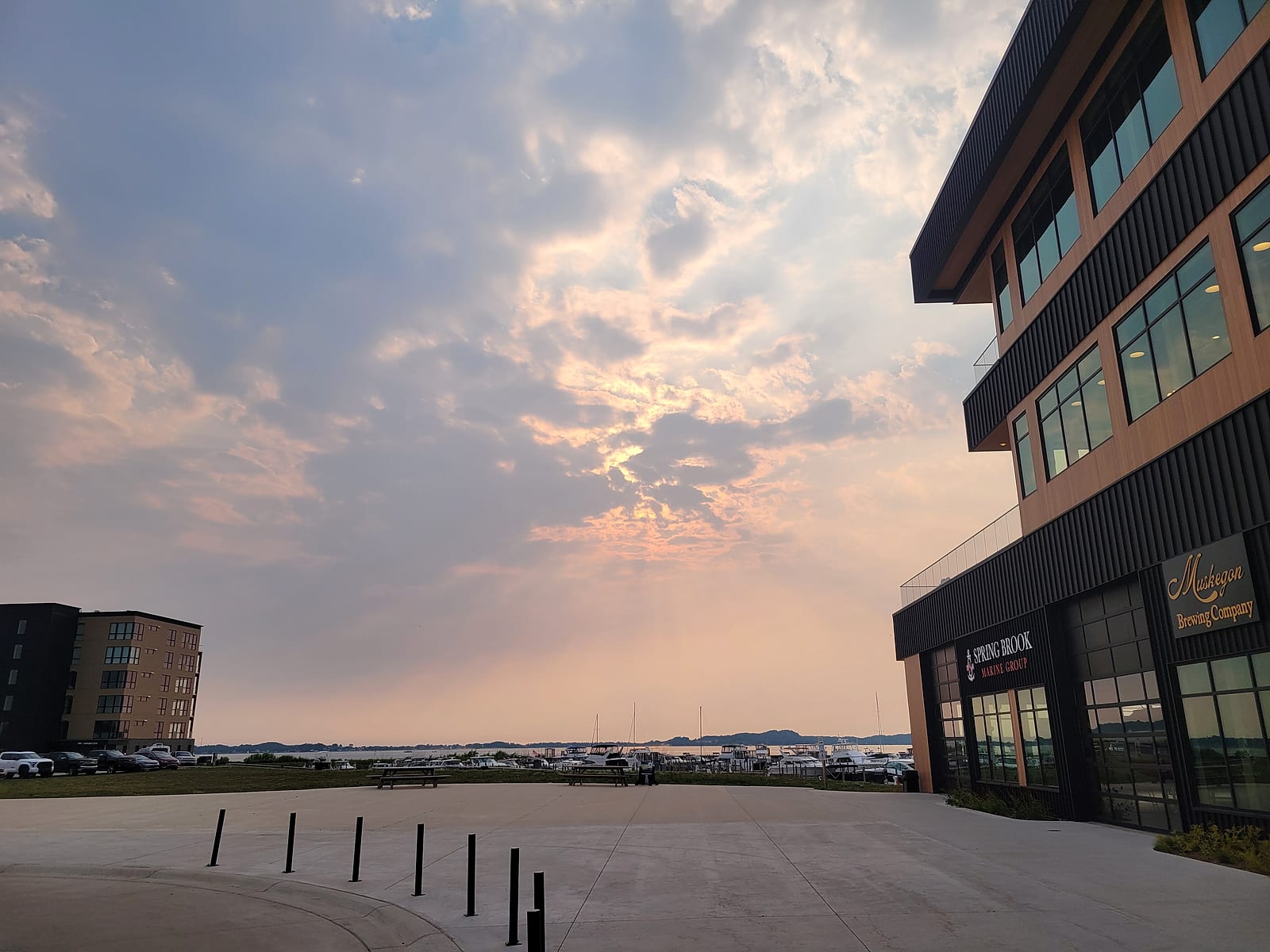
One floor up, the Adelaide Events Center opened in 2024 with a private patio and what its site calls panoramic 270-degree water views, booking weddings, corporate events, and private parties, with Muskegon Brewing Company as its exclusive caterer.
Public Access, and the Hartshorn Question
Adelaide Pointe is private property with public obligations written into its approvals, and the distinction matters on the ground. The Lakeshore Trail runs through the campus on a route the City Commission approved in a July 2023 property exchange. The city's 2023 public documents describe park amenities planned on the two peninsulas flanking the marina basin, open to the public, and a roughly 800-foot public fishing pier along the marina breakwall, funded in part by a $1 million state appropriation - that pier length is the 2023 plan figure, not a measurement anyone has published since. The pier is more than a plan now: as of October 2026, the operator's own amenities page, which names it Leestma Park and Pier, describes it as elevated over the water, open to the public, wrapping around the west side of the marina just off the bike path.
Under a cooperative-use agreement signed in September 2022, the developer received non-exclusive commercial access to the launch and forklift areas at neighboring Hartshorn Park in exchange for public-access easements across its private peninsulas and frontage. The city has stated flatly, and more than once, that no parkland was sold or conveyed.
Hartshorn needs separating out, because the two get conflated constantly. Hartshorn Municipal Marina, immediately east of Adelaide Pointe, is owned by the City of Muskegon and is the only publicly owned marina on Muskegon Lake - 76 major slips by the city's count, plus moorings and two public launch ramps, on about ten acres. Adelaide Pointe's operators managed Hartshorn for a period after acquiring the company that held the management contract, and the city announced in April 2024 that it was resuming direct management that May. If you want a public slip or a public ramp, Hartshorn is the address, and the fees, limits, and alternatives are covered in this site's guide to Muskegon Lake's public launches and marinas.
The relationship between private development and public access here has had friction - trail routing, fishing access, and parking have all drawn public comment through the city's engagement process, and the arrangements have been renegotiated more than once. The durable fact is that the public-access obligations sit in recorded agreements and city approvals, and they have so far survived every twist in the project's fortunes. A separate 2025 consent agreement with the state calls for wetland restoration and regrading on the peninsulas and the marina's southern shoreline; the restructuring officer reports that the companies oppose carrying it out, and the status section below covers it, including the alternative the companies proposed in October.
Cleanup Money and Conflicting Price Tags
A site with this history is a brownfield by definition, and the paper trail is public. A Phase II environmental assessment completed in December 2020 documented widespread contamination from the industrial decades: tetrachloroethylene and a list of metals in soil above the state's residential cleanup criteria, with benzene, naphthalene compounds, and more metals in the groundwater. The city's brownfield plan also records that the developer completed a Baseline Environmental Assessment and is not the liable party for the historical contamination. A documented cleanup obligation is not the same thing as a hazard to someone walking the trail today - what it mostly means is money, process, and regulators in the room for years.
Public support has come in several forms, all city-reported in early 2023: a $250,000 federal forestry grant tied to the mass-timber construction, a $1.5 million Boating Infrastructure Grant toward the marina, and the $1 million state appropriation for the public fishing pier. The brownfield plan itself works by tax-increment financing - eligible cleanup and infrastructure costs get reimbursed over many years out of the increased property taxes the redeveloped site generates. Even that structure has already shifted once: the 2022 plan capped the city's bond participation at $10.5 million, but a second amendment the city took up in March 2023 recorded that the developer was no longer seeking city bonds for the public infrastructure - the city would not be bonding for, paying for, or constructing any of the assets, and the tax-increment reimbursement was restructured so the developer recovers the eligible costs itself.
As for what the whole thing costs, pick your source and your year: the 2022 brownfield plan put private investment for the first three phases at about $125 million; the 2021 version of the plan and the Public Finance Authority described a $250 million full build-out; news coverage in July 2026 called it an $85 million development. Each number measures a different scope on a different date.
Where Things Stand: October 2026
On April 1, 2026, Leestma Management and four related companies - including Adelaide Pointe QOZB, Adelaide Pointe Boaters Services, and Adelaide Pointe Building 1 - filed voluntary Chapter 11 petitions in the U.S. Bankruptcy Court for the Middle District of Florida. The five cases are jointly administered in Tampa under Leestma Management's case, 8:26-bk-02696. The filing followed a lender dispute: Crain's Grand Rapids reported that Independent Bank had alleged default on part of a $28 million loan, and a state court had appointed a receiver about two months before the bankruptcy.
Chapter 11 is a reorganization process, and the developer's bankruptcy attorney said publicly that the operating businesses - the wet and dry marinas, the mixed-use building, the restaurant, and the events operation - were not among the assets in the April 2026 filing. Court filings since then show part of the structure behind that, and the same structure is now the subject of the foreclosure dispute and the September 2026 bankruptcy filing described below. Bear Lake Tavern, which Emily Leestma has owned through a separate company since 2022, is also not among the five debtor entities.
The turn came through mediation. The parties spent June 2026 in a judicial settlement conference before Chief Bankruptcy Judge Jacob Brown and came out with a Phase One interim settlement, which the court approved by order entered July 20, 2026. The term sheet filed with that motion is specific. John Polderman moves from state-court receiver to chief restructuring officer across all five companies, and the interim period runs to December 31, 2026. The companies and the Leestmas release their claims against Polderman and the three participating secured lenders.
Michigan's environmental agency and the Attorney General hold off enforcement on wetland restoration for 120 days while that dispute stays in mediation, keeping the right to assess penalties afterward if no formal extension is agreed. Pending litigation in both the bankruptcy and the Michigan receivership case is stayed to the end of the year. The restructuring officer also picks up compliance with the City of Muskegon and the state, and the agreement names who will help him: Frank Peterson, Muskegon's city manager from 2013 to 2022, retained for exactly that work. Separately, the restructuring officer is directed to seek estimates for all the work still required to complete the condo project.
The same document says what happens if this stalls. If the companies do not file a Chapter 11 plan on terms agreeable to those lenders by the end of the interim period, or one that pays them in full within two years of a confirmation date with debt service at the contract rate starting in January 2027, the automatic stay lifts as to those lenders. The automatic stay is the freeze on collection that a bankruptcy filing puts in place. December 31, 2026 is the date to watch: past it, without an acceptable plan, the term sheet leaves those lenders free to act on their collateral.
The Chapter 11 case itself stayed procedural after the July order. On July 30 the companies asked the court to extend their exclusivity period, the stretch during which only they may file a Chapter 11 plan and disclosure statement, through December 31, 2026 (Debtors' motion, Doc. 234, filed July 30, 2026). That request, the continued use of cash collateral, and an application to employ counsel for John Polderman in his restructuring-officer role were set for one hearing on August 27, then rescheduled to September 2, 2026 in Tampa (Doc. 269, filed August 27, 2026).
The hearing went ahead. The court's hearing memo, dated the day of the hearing and entered on the docket the next day (Doc. 277), records the outcome: the exclusivity request granted as discussed in open court, the restructuring officer's counsel approved, and cash-collateral use continued on an interim basis to a September 9 hearing. It also records the court's statement that it will schedule a confirmation hearing for February 18, 2027 once a plan is filed. The document itself notes that it is not an official order of the court. A fourth matter heard that day, the companies' motion to keep West Shore Bank from foreclosing on 500 Adelaide Circle, is covered in its own section below, and its written order followed on September 10. The court granted the exclusivity request by order entered September 16, 2026, extending that period through December 31, 2026 (Doc. 288), and approved the restructuring officer's counsel by order entered October 6, 2026 (Doc. 315).
No plan and no disclosure statement had been filed as of October 23, 2026. The September 9 cash-collateral hearing went ahead. The restructuring officer filed a proposed fourth cash-collateral order covering August through December 2026 (Doc. 280, filed September 9, 2026), and the court's memo of the hearing, entered September 11, records no ruling on the request, only that the restructuring officer's counsel is to file a proposed agreed cash-collateral order by September 14, 2026 (Doc. 283). The court then entered a fourth interim cash-collateral order on September 16, 2026, and a corrected version on September 26 (Docs. 287, 307).
The court-run settlement talks ended on September 9, the day of that hearing. The judge who had been running them since June filed a final report that day: he had kept talking with the restructuring officer, the companies, and Independent Bank about the terms of a plan, the talks had reached an impasse, more of them would not produce a plan everyone agreed to, and he was closing the process (Final Judicial Settlement Conference Report, Doc. 279, filed September 9, 2026). In plain terms, the June deal stands and the bankruptcy case goes on, but the table the court set up for working out the rest is gone. The companies can still file a plan on their own, and the lenders can still object to whatever they file; what has ended is the court-supervised process for agreeing on one first. The report does not mention the wetlands matter, and nothing in it changes the dates set out above, which leaves December 31, 2026 as the date that matters for the plan.
On October 7, 2026 the three Adelaide Pointe companies in the case, Adelaide Pointe QOZB, Adelaide Pointe Boaters Services, and Adelaide Pointe Building 1, asked the court to approve a new loan to finish the condo building (Debtors' motion for post-petition financing, Doc. 319, filed October 7, 2026). The lender would be 364 Capital, LLC, a Delaware company the motion says has no prior relationship with the companies. The facility is up to $13,780,000 at 14 percent interest for two years, secured by a lien that would rank ahead of Independent Bank's on the condos, the storage warehouses, the boater-services building, and the undeveloped campus land.
The budget attached to the motion puts $5 million toward construction: finishing the 34 unsold units, the pool, the lobby and hallways, landscaping, and what the motion calls an engineered remediation of the residential balconies. The motion itself describes the 34 unsold units as unfinished and unmarketable until that work is done. The rest would cover unpaid and 2026 property taxes, an interest reserve for Independent Bank, professional fees, payments to three vendors the companies describe as critical, and the lender's own fees and interest reserve. No loan money moves unless the court enters a final order. The restructuring officer's October 13 report comments on the motion, Independent Bank has asked the court to strike it, and the companies have answered, all described below. The motion was on the court's October 21, 2026 calendar for a preliminary hearing, and the court deferred its ruling (the court's hearing memo, Doc. 331, entered October 22, 2026). An amended version of the motion filed October 21 changes none of the loan terms; it completes an unfinished sentence and adds one more, saying that the future work of the building's former construction manager, which the motion names as Catalyst Construction, would be the balcony remediation, and that the company is familiar with that work and agreeable to doing it upon an agreement for future work and payment of its claim from before the bankruptcy (Debtors' amended motion, Doc. 327, filed October 21, 2026, para. 26; the commitment letter and budget were refiled with it the same day as Doc. 329).
Also on October 7, Building 1 asked the court to fix the value of Independent Bank's collateral in the condo building and to treat the bank's claim as secured only up to that value (Doc. 320, filed October 7, 2026). The motion attaches an August 24, 2026 letter from the bank to the condominium association's board in which the bank states that it has no obligation to fund further development or completion of the project, that completion is the responsibility of the owner and developer, and that it has identified items, such as the condo balconies, that may justify protective advances to protect its collateral (Doc. 320, Ex. B). The motion is on 30-day notice, and Independent Bank's October 15 motion, described below, asked the court to strike it or put it on hold.
In plain terms, the condo building is not finished, the developer companies are asking a new lender for the money to finish it, and the existing bank has told the condominium association in writing that it has no obligation to pay for that. Both motions are requests. As of October 23, 2026 the court had not ruled on either, and Independent Bank, whose lien the new loan would move ahead of, asked the court to throw both out or put them on hold; the court's memo of its October 21 hearing records that request as denied, as described below.
On October 13, 2026 the restructuring officer filed an interim report with the court (Interim Report of the Chief Restructuring Officer, Doc. 322-1, filed October 13, 2026). He concludes that, at this stage of the case, a feasible Chapter 11 plan cannot be proposed, while stating that the report does not conclude reorganization can never be achieved. He names two obstacles: a 2025 consent agreement with Michigan's environmental agency that requires wetland restoration at the marina, and the absence of sufficient committed funding to carry it out. He reports that compliance is estimated to cost $1.5 million to $4 million, and he says most of the work would take place on land owned by Adelaide Pointe Wet Marina, LLC, which is not one of the companies in the case. As he understands the October 7 loan request, it appears to include money for site-assessment work on the agency's requirements but does not presently provide committed funding sufficient to carry out the agreement. The companies' motion describes the loan as resolving the environmental claim (Doc. 319 at 3).
The agreement is attached to the report (Doc. 322-2). Entered into in April 2025 by the agency's water resources division, Ryan Leestma, and Adelaide Pointe QOZB, it sets out steps that, once successfully completed, the agency will deem to resolve the violations it alleged in notices issued in 2023 and 2024. It states that it is not an admission of liability, and also that by signing, Leestma and the company gave up the right to contest the agency's determination of how much wetland restoration is required. It calls for about 2.2 acres of wetland restoration, including removing rock from the tip of the central peninsula and regrading parts of the central and western peninsulas and the marina's southern shoreline. The first half is to be completed by November 1, 2026 and the rest by November 1, 2027, followed by at least five years of monitoring. The officer reports that the companies oppose carrying it out and that he and the companies are at an impasse.
Their position, which the officer says is summarized in an excerpt from a technical report attached to his filing, is that the agreement's wetland requirement cannot be met on this site and that the required regrading would set off erosion ending, in their analysis, in failure of the marina basin and loss of public access. They propose keeping the existing engineered shoreline, establishing a wetland of half an acre to an acre inside the marina basin, and paying in-lieu-fee mitigation for the rest (Doc. 322-3).
He recommends that the court hold a status conference at the earliest practicable time. If the steps he lists, including verifying the first restoration milestone and obtaining written funding commitments, cannot be completed within a supportable timeframe, he says, the companies and other parties in interest should evaluate an asset sale, a liquidating Chapter 11 plan, conversion, or dismissal, as appropriate. He also notes that under the agreement, Ryan Leestma and Adelaide Pointe QOZB keep their unfinished work obligations, and enough interest in the property to do the work, even after a sale, unless the agency approves an assignment and releases them. The report states that it does not itself ask the court to convert or dismiss the case, approve a sale, or grant other relief of that kind, and as of October 23, 2026 the court had not acted on it.
In plain terms, the restructuring officer the court approved for these companies has told the court that, on the record as it stands, he cannot support a plan to keep the project going. The main reason is a state wetland agreement that the companies lack sufficient committed money to carry out and that the developer says cannot work. That is his assessment; the court has not ruled on it.
On October 21, 2026 the five companies in the case replied to the restructuring officer's report (Debtors' reply to the interim report, Doc. 330, filed October 21, 2026). They say the 2025 consent agreement is a contract the companies can take on or reject in the bankruptcy, that under Michigan law a permit applicant who qualifies may use approved credits from a wetland mitigation bank in place of other compensatory wetland mitigation, and that credits covering the 2.2 acres of wetland impact could cost about $300,000, a figure they set against the $1.5 million to $4 million the officer estimated for compliance with the agreement as a whole. They call this an overlooked option that they say would comply with Michigan law and with the agency. The reply also states that the companies' counsel, after consulting the officer and the companies, is not aware of any claim by the agency that the violations or the project's current condition are causing an environmental, health, or public safety concern. No filing read for this page says whether the agency would accept credits in place of the restoration the agreement describes, and as of October 23, 2026 the court had not acted on the report or the reply.
On October 15, 2026 Independent Bank asked the court to strike both October 7 motions, the loan request and the condo valuation request, or else to put them on hold until the issues raised by the settlement judge's September report and the restructuring officer's October report are resolved (Independent Bank's motion to strike or stay, Doc. 324, filed October 15, 2026). The bank says the restructuring officer did not approve either motion, that under the June settlement and the court's approval order he holds final decision-making authority for the companies on matters outside the plan, and that the motions begin the kind of litigation the settlement paused through December 31, 2026. On October 21 the three companies answered that the settlement did not remove them as debtors in possession or give the officer the exclusive authority the bank describes, that the only language in the settlement bearing on the bank's point is an injunction against legal actions over the earlier disputes with the participating lenders, and that the loan request is meant to carry out the settlement, including its requirement that those lenders be returned to debt service at the contract rate by January 1, 2027 (Debtors' response, Doc. 328, filed October 21, 2026). They add that the valuation request is in support of the loan request, meant to determine the value of the condo building collateral and the secured status of the lienholders' claims before a new lender comes in. The court's memo of the October 21 hearing records the bank's motion as denied and the ruling on the loan motion as deferred (Doc. 331, entered October 22, 2026); the memo notes that it is not itself an official order, and as of October 23, 2026 no written order on either had been entered and the court had not ruled on the loan motion or the valuation motion.
In plain terms, three things are in front of the court at once: the officer says there is not enough committed money to carry out the state environmental agreement, the companies say a cheaper way to satisfy it exists, and the bank said the developer's side had no authority to ask for the loan without the officer. The court's hearing memo records the bank's request as denied at the October 21 hearing, and the court has not yet ruled on the loan itself or on the environmental question.
The 500 Adelaide Circle Foreclosure Dispute
Adelaide Pointe is a group of companies under one developer, each owning a different piece of the project. Five of them filed for Chapter 11 in April 2026, which froze collection against those five while they work out a plan to pay their debts. The restaurant and event-center building belongs to another company in the same group, Adelaide Pointe Multi-Use, LLC, which was not part of that April filing, and its lender, West Shore Bank, scheduled a foreclosure sale of the building for September 18, 2026.
The five asked the bankruptcy judge to rule that the freeze already covers the building, since they own the company that owns it, or else to extend the freeze to cover it (Doc. 261 at 2 and 3). The bank answered in August that the building belongs to a company outside those five cases, so the freeze does not reach it, and that the only way that company gets the same protection is to file its own case (Doc. 268 at 2). The judge denied the companies' request at the September 2 hearing and put it in writing the following week: the freeze is not in effect for, and does not extend to, property owned by the building's owner, including the building itself (Doc. 277; Doc. 281 at 2). That ruling was about the freeze in the five companies' cases. Those cases continue, and at the same hearing the judge granted their request to extend their exclusive window to file their plan. On September 15, 2026 the building's owner filed a Chapter 11 case of its own. A Chapter 11 filing freezes collection against the company that files, and a lender can ask the court to lift that freeze. West Shore Bank did so on October 9, 2026, asking the court in the building owner's case to lift the freeze so the bank can pursue its remedies, including a foreclosure sale of 500 Adelaide Circle (Doc. 27 in the Multi-Use case at 5 and 6). At a hearing on October 21, 2026 the court continued that request to a later date, and the same hearing memo records the bank's separate request to bar the company from using cash the bank says is its collateral as granted as discussed in open court, with no further detail in the memo (Doc. 33 in the Multi-Use case). That motion describes the September 18 sale only as scheduled, and as of October 23, 2026 no filing read for this page says that sale took place.
On September 9 the judge who had been running settlement talks among the companies, their court-approved restructuring officer, and Independent Bank since June reported that the talks had hit a dead end and closed them (Doc. 279). The June settlement those talks produced still stands and the case goes on, but the companies now have to write their plan without a deal agreed in advance, and the lenders can object to whatever they file. The June settlement's own deadline is the one to watch: if there is no plan by December 31, 2026 that those lenders accept, or that pays them in full on the schedule it sets, the freeze lifts for them and they can go after their collateral.
The businesses inside the building, including the restaurant and the event center, are tenants there, and none of them is one of the companies that filed for Chapter 11 (Doc. 268 at 4). The restaurant was open for business on October 8, 2026.
Different parts of the development belong to different companies. The four-story building at 500 Adelaide Circle, with Muskegon Brewing Company on its second floor and the event center above it, belongs to Adelaide Pointe Multi-Use, LLC, which was not one of the five and which filed a Chapter 11 case of its own on September 15, 2026, described below. The dry and wet marina properties belong to Harbor West QOZB, LLC and Adelaide Pointe Wet Marina, LLC, which the companies described as non-parties in a Michigan receivership filing in March 2026 (Doc. 268, Ex. 3 at 101). None of the three is among the five debtors in these cases, and when the two sides argued over the foreclosure in August 2026 both described the owner of 500 Adelaide Circle that way (Doc. 261 at 2; Doc. 268 at 2). All three did sign the June settlement term sheet, so the settlement reaches them even though these five cases do not.
That structure has produced a second fight. West Shore Bank holds two mortgages on the 500 Adelaide Circle property, securing notes of $6,575,000 from February 2024 and $500,000 from April 2025 (West Shore Bank's response in opposition, Doc. 268, filed August 26, 2026, at 2 and 3), and recorded a notice of default in March 2026 (Doc. 268 at 4). It partially participated in the June settlement conference but did not join the interim settlement the other secured lenders reached, which the companies confirm in their own motion (Debtors' emergency motion, Doc. 261, filed August 20, 2026, at 3). West Shore scheduled a foreclosure sale on the property for September 18, 2026, a date both sides gave (Doc. 261 at 3; Doc. 268 at 4).
On August 20 the companies asked the court to enforce the automatic stay against that sale, or failing that to extend it to Multi-Use, and to hold West Shore in civil contempt (Doc. 261 at 3). West Shore, appearing as a non-party, answered on August 26 that owning a company is not the same as owning its property, and that if Multi-Use wants bankruptcy protection it has to file its own case (Doc. 268 at 2). The motion was set for the September 2, 2026 hearing (Doc. 271, filed August 28, 2026), heard that day with the case's other pending matters, and denied (hearing memo, Doc. 277, entered September 3, 2026). The written order, dated September 9 and entered September 10, 2026, denies the motion and states that the automatic stay is not in effect as to, and does not extend to, property owned by Adelaide Pointe Multi-Use, LLC, including 500 Adelaide Circle, for reasons the court gave orally at the hearing (Doc. 281 at 2).
On September 15, 2026, three days before the September 18 sale date, Adelaide Pointe Multi-Use, LLC filed a voluntary Chapter 11 petition of its own in the same court, Case No. 8:26-bk-08333-CED. The same day the court entered its standard opening order, a form it enters in every Chapter 11 case filed there: the building's owner may keep operating its business (Doc. 2 in the Multi-Use case). It is not a decision about this company in particular. In its case management summary, filed September 29, the company says it filed "to preserve the Multi-Use building," which it calls an important part of the larger project (Doc. 20 in the Multi-Use case). On October 9, 2026 West Shore Bank asked the court in that case to lift the automatic stay so the bank can pursue its remedies, including a foreclosure sale of 500 Adelaide Circle, or, in the alternative, to keep the stay in place only if the bank's interest in the property is protected (Doc. 27 in the Multi-Use case at 5 to 8). In a separate motion it asked the court to bar the company from using cash the bank says is its collateral (Doc. 28 in the Multi-Use case). Both motions came before the court on October 21, 2026, together with the company's first status conference. The court's memo of that hearing records the stay-relief request as continued to a later date (the same day, the company filed an agreed motion to reschedule the hearing on it, Doc. 31 in the Multi-Use case) and the cash-collateral request as granted as discussed in open court, with no further detail in the memo (Doc. 33 in the Multi-Use case, entered October 22, 2026); the memo notes that it is not itself an official order, and as of October 23, 2026 no written order on either had been entered. At the status conference the court directed that an order be entered setting January 13, 2027 as the company's deadline to file a plan and disclosure statement (Doc. 33). West Shore's motion and the company's summary both describe the September 18 sale only as scheduled, and neither says it took place.
West Shore says it is foreclosing by advertisement (Doc. 268 at 4). Under that procedure the sale date opens a statutory redemption period rather than transferring the building, and the purchaser's deed is void if the property is redeemed before that period runs out (MCL 600.3240). The same filing states that none of the tenants in the building are among the five companies in Chapter 11. The sale date itself can move. Muskegon County holds mortgage foreclosure sales on Fridays at the Michael Kobza Hall of Justice, and the county says sales may be adjourned without prior notice, with adjournments posted weekly in that building's lobby. Whether a scheduled sale went ahead or was adjourned is a question for the county rather than the bankruptcy docket.
Meanwhile the place keeps running. Boaters posted verified reviews through early July, and I eat at the restaurant myself: in August 2026 the slips were busy, and on October 8, 2026 the slips were still in use and the kitchen was open for business. Both things are true at once.
What should a reader do with all that? If you are a boater, the practical picture is a large, modern, operating marina; book the slip and enjoy it. If you are considering buying real estate here, the bankruptcy is neither a reason to walk away nor a detail to wave off - it is a reason to do the paperwork-heavy version of due diligence, with current title work, escrow protection, and your own read of the docket, which is public.
The account above is drawn from filings on the public docket in In re Leestma Management, LLC, No. 8:26-bk-02696-CED (Bankr. M.D. Fla., Tampa Division), where all five cases are jointly administered. Document numbers refer to docket entries in that case unless another case is identified. A court filing states the position of the party who filed it; filings are allegations, not findings by the court. The Leestma docket was reviewed October 23, 2026, through entry 332. The separate case Adelaide Pointe Multi-Use, LLC filed in the same court on September 15, 2026, No. 8:26-bk-08333-CED, was reviewed the same day, through entry 33. This is not legal or financial advice, and the docket itself is the authority for anything you plan to rely on. If you think something here is wrong, tell me and I will correct it.
A brand-new building on brand-new docks can hide as much as an old one: developer-controlled associations, unfinished phases, unrecorded promises, and a shoreline whose water levels move on their own schedule. The Muskegon waterfront flooding and hidden risks guide walks through the checks, here and on every other shoreline around the lake.
Common Questions
Where is Adelaide Pointe in Muskegon?
On the south shore of Muskegon Lake at the west end of West Western Avenue, between downtown and the Lakeside neighborhood, where the street grid gives way to the old industrial lakefront. The marina office is at 400 Adelaide Circle, Muskegon, MI 49441; the restaurant, the event center, and a boat showroom run by Spring Brook Marine Group share the mixed-use building at 500 Adelaide Circle. The city's Hartshorn Municipal Marina sits immediately to the east.
How many slips does Adelaide Pointe Marina have?
The answer depends on which page you read: the operator gives two counts on its own site (169 total with 33 of them transient on one page, 163 reserved plus those 33 on another) and the Marinas.com directory gives a third (161). All of them land north of 160. Lengths span 40 to 70 feet for boats up to about 80 feet, and the dockmaster's office is the only source that can tell you what is actually open in a given season.
Is Adelaide Pointe still open during the bankruptcy?
Yes, as of October 2026. On October 8, 2026 the slips were in use and Muskegon Brewing Company was open for business; I eat there myself and see the boats, and news coverage of the case quotes the companies' attorney saying the day-to-day businesses were kept out of the April 2026 filing. Chapter 11 restructures debt while operations continue. A separate dispute involves the four-story building at 500 Adelaide Circle, which is owned by Adelaide Pointe Multi-Use, LLC, a company in the same group that was not among the five that filed in April 2026: West Shore Bank scheduled a foreclosure sale on that building for September 18, 2026, and those five companies asked the bankruptcy court to stop it. The court denied that request on September 2, 2026, and its written order of September 10 says the automatic stay in those five cases does not extend to property owned by that company, including the building. Multi-Use then filed its own Chapter 11 case on September 15, 2026, so that company is in bankruptcy too, in a separate case, and on October 9, 2026 West Shore asked the court in that case to lift the automatic stay that Multi-Use's own filing created, so the bank can pursue its remedies, including a foreclosure sale of the building. At a hearing on October 21, 2026 the court continued that request to a later date, and as of October 23, 2026 it had not ruled on it; no court filing read for this page says the September 18 sale took place. West Shore says it is foreclosing by advertisement, and under Michigan law a foreclosure sale by advertisement opens a statutory redemption period rather than transferring the building on the day of the sale. Even so, check the latest coverage before you plan around any particular outcome.
How many condos does Adelaide Pointe have?
Fifty-five in the first building, a six-story mass-timber tower, according to the developer's own court filings in October 2026, which also say 34 of them were unsold and unfinished at that point; the WoodWorks Innovation Network's project record puts the count at about 50. Later phases sketched more condominiums and a hotel; check what actually stands before treating any of that as real.
Are the trail and fishing pier at Adelaide Pointe open to the public?
Yes, as of October 2026: the operator's site lists the elevated fishing pier, which it now calls Leestma Park and Pier, as open to the public, and the bike path runs through the campus. That access is written into city agreements: the Lakeshore Trail was rerouted through the development under a property exchange the City Commission approved in July 2023, the two peninsulas beside the basin were designated for public park space, and the pier carried $1 million in state funding. Construction, maintenance, or events can still close a stretch temporarily, so treat posted signage as the current word.
Is Hartshorn Marina part of Adelaide Pointe?
No. Hartshorn Municipal Marina is city property - the city describes it as the only publicly owned marina on the lake - and sits just east of the development. Adelaide Pointe managed Hartshorn for a stretch, but the city took day-to-day management back in May 2024. What the neighbors share is a shoreline and a cooperative-use agreement; ownership stays separate.
Can you get dinner at Adelaide Pointe without owning a boat?
Yes. Muskegon Brewing Company, on the second floor of the building at 500 Adelaide Circle, is a public restaurant, with eight signature beers that, by the restaurant's own account, are brewed for it by Muskegon's own Pigeon Hill Brewing Company. Arriving by water works too: ten short-stay slips are set aside for diners who come in off the lake. Hours shift with the seasons, so check the restaurant's site or socials before driving out.
Sources
- City of Muskegon Brownfield Plan Amendment for Adelaide Pointe, 2022 - the 35-acre site, five phases, the 55-unit plan figure, the December 2020 environmental findings, and the tax-increment structure; the developer's move away from city bonds is recorded in the city's March 14, 2023 board agenda covering the second amendment
- City of Muskegon Lower West Western FAQs, February 2023 - the grant awards, the 800-foot pier plan, the peninsulas, and the no-parkland-conveyed statements
- City of Muskegon Lower West Western site timeline - the September 2005 Westran-to-Kirksey sale and the March 2021 sale for the development; purchase details (buyer entity, sellers, the reported $5.5 million) from MiBiz's August 2021 report
- Lakeland Boating, February 2023 - the developer's slips-for-80-foot-plus-boats pitch, quoted during construction
- City of Muskegon engagement page: Hartshorn Marina and Adelaide Pointe - the July 2023 trail property exchange and the May 2024 return of Hartshorn management; and the city's Hartshorn Municipal Marina page
- WoodWorks Innovation Network: Adelaide Pointe Condominiums - six stories, about 50 units, and the cross-laminated timber structure
- Adelaide Pointe: history, boat slips, and amenities - the lumber-mill and foundry story, the marina's slip and amenity claims, and the pier-open-to-the-public description (attributed as the developer's marketing where used; reviewed October 2026)
- Muskegon Brewing Company and the Adelaide Events Center - the 1876 brewery history, the Pigeon Hill partnership, and the venue details
- Spring Brook Marine Group, January 2025 - the company's announcement of its showroom at 500 Adelaide Circle
- WGVU, July 6, 2026 and Crain's Grand Rapids, April 2026 - the bankruptcy filing, the lender dispute, and the interim settlement. The court record is In re Leestma Management, LLC, Case No. 8:26-bk-02696-CED, U.S. Bankruptcy Court for the Middle District of Florida, Tampa Division, where all five cases are jointly administered. The settlement terms on this page were read from the Debtors' Motion to Approve Mediated Interim Settlement Agreement Term Sheet and its exhibit, Doc. 217, filed June 25, 2026. The West Shore Bank foreclosure dispute was read from Doc. 261, filed August 20, 2026, and Doc. 268 with its exhibits, filed August 26, 2026; the hearing schedule from Doc. 269, filed August 27, 2026, and Doc. 271, filed August 28, 2026; the September 2 hearing rulings from the court's hearing memo, Doc. 277, entered on the docket September 3, 2026; the end of the judicial settlement process from the Final Judicial Settlement Conference Report, Doc. 279, filed September 9, 2026; the written order on the stay motion from Doc. 281, entered September 10, 2026; the September 9 cash-collateral hearing from the court's memo, Doc. 283, entered September 11, 2026; the exclusivity extension from the order entered September 16, 2026, Doc. 288; the fourth interim cash-collateral order and its corrected version from their docket text, Docs. 287 and 307, entered September 16 and September 26, 2026. The September 15, 2026 Chapter 11 case of Adelaide Pointe Multi-Use, LLC, No. 8:26-bk-08333-CED in the same court, was read from its docket; from the court's standard Order Authorizing Debtor-in-Possession to Operate Business, Doc. 2, entered September 15, 2026, which carries the case number as first assigned; and from the company's Case Management Summary, Doc. 20, filed September 29, 2026. The order approving the restructuring officer's counsel was read from its docket text, Doc. 315, entered October 6, 2026; the October 7, 2026 financing motion, with its commitment letter and budget, is Doc. 319; the motion to determine Independent Bank's secured status is Doc. 320, filed October 7, 2026, and its Exhibit B is the bank's August 24, 2026 letter to the condominium association. The restructuring officer's interim report and its two exhibits, the 2025 consent agreement and an excerpt from a technical report that the officer says summarizes the companies' arguments, were read from Docs. 322-1, 322-2 and 322-3, attachments to the notice of filing at Doc. 322, filed October 13, 2026. West Shore Bank's October 9, 2026 motion for relief from the stay in the Multi-Use case was read from the motion itself, Doc. 27 at 1 to 8, and its motion on cash collateral, Doc. 28, from its docket text. Independent Bank's motion to strike or stay, Doc. 324, filed October 15, 2026, and the companies' response to it, Doc. 328, and reply to the officer's report, Doc. 330, both filed October 21, 2026, were read in full; their amended financing motion, Doc. 327, filed the same day, was read and compared against the original, Doc. 319, and Doc. 329, also filed that day, is the notice refiling the original's commitment letter and budget. The rulings from the October 21, 2026 hearings were read from the court's hearing memos, Doc. 331 in the Leestma case, read from its docket text, and Doc. 33 in the Multi-Use case, both entered October 22, 2026; the Multi-Use company's agreed motion to reschedule, Doc. 31, from its docket text. Case status reviewed October 23, 2026. Filings come from PACER, the federal courts' official records system, which charges by the page and is the authoritative source; PacerMonitor publishes a free summary of recent docket entries without the documents themselves
- Muskegon County Sheriff's Office: Mortgage Foreclosure Sales - when and where the county's mortgage foreclosure sales are held and how adjournments are posted (fetched September 2026)
- Marinas.com: Adelaide Pointe Marina - the third-party slip count and the review record from the construction years to July 2026
- Grand Rapids Magazine, June 2022 - the Leestmas' purchase of Bear Lake Tavern (the tavern business is Emily Leestma's, held through a separate Michigan company in good standing per the state registry as of September 2026, and it is not a debtor in either 2026 case)
The Agent on the Listing Works for the Seller
Every listing, yard sign, and community page carries a contact, and that person represents the seller - a listing agent under contract to the seller, or at a new development the developer's own sales staff. Anything you share before you have representation of your own - budget, timeline, how much you want the unit - can serve the seller's side of the table.
Buyers do better with their own agent, from a different brokerage, whose only loyalty in the deal runs to them. Who pays that agent is negotiated and put in writing before you tour, and a seller can agree to cover it in the purchase agreement. How agency works in Michigan, and why the stakes are higher on a condo purchase, is covered in the buyer checklist.
How agency works in MichiganRelated Guides
Muskegon Waterfront Condos & HOA Guide
How Adelaide Pointe compares with the area's other condo communities, and what an association actually controls.
Read the guideWaterfront Condo Buyer Checklist
The documents to request before buying here - association control, escrow, reserves, and exactly what conveys with a slip.
Read the checklist