Harbour Towne: Muskegon's Condo Community Between Three Waters
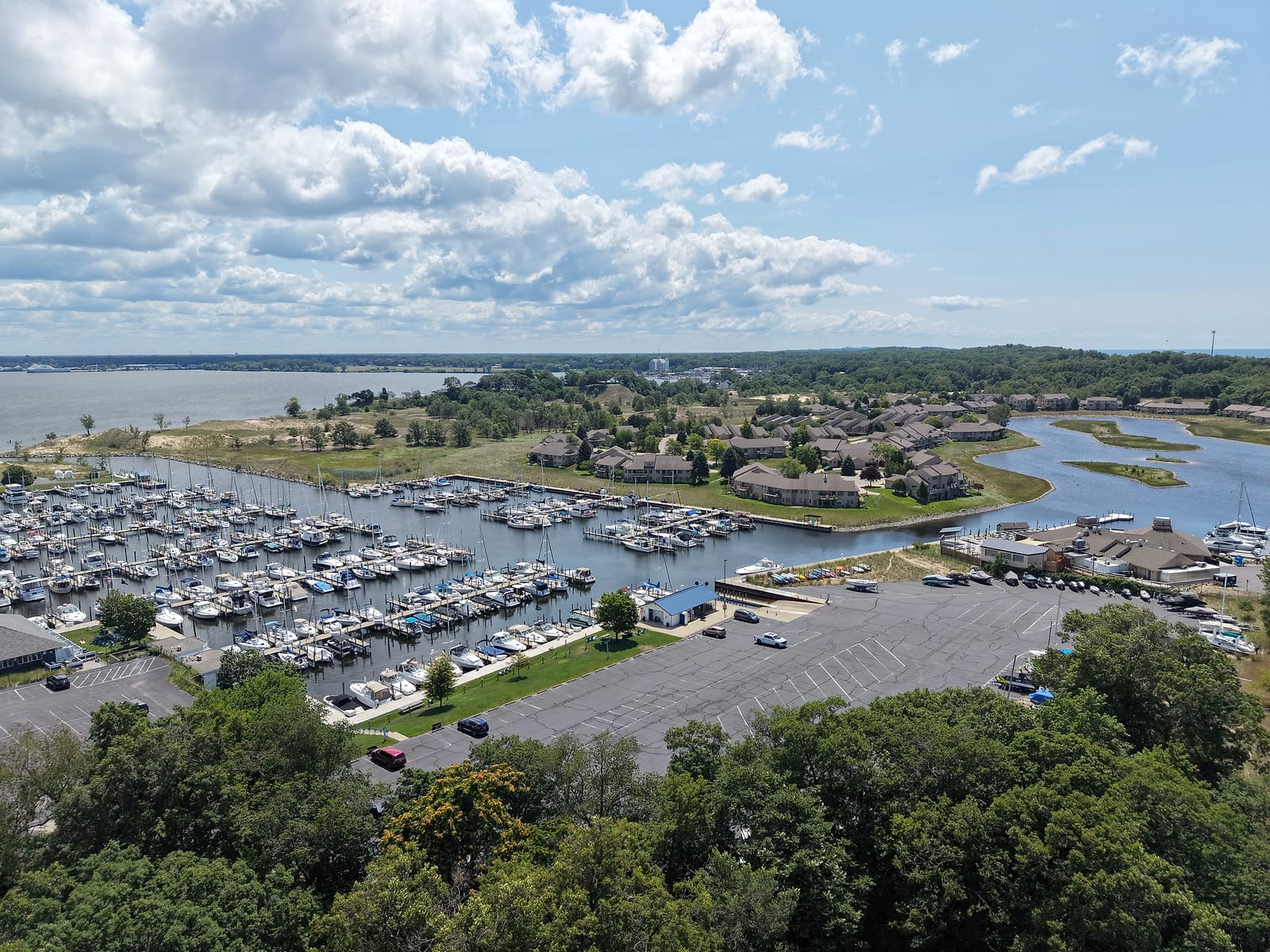
Harbour Towne sits at the Lake Michigan end of Muskegon's Bluffton neighborhood, on the peninsula that forms the south side of the channel. It is 190 condominiums, a privately owned dockominium marina, engineered lagoons, a restaurant, and a public city beach, all sharing ground that used to be one of Muskegon's most famous sand dunes. No other condo community in the area touches Muskegon Lake, the channel, and Lake Michigan at once - and none of the others has a backstory like this one. For how Harbour Towne fits among the area's other communities, start with the waterfront condos guide.
Last reviewed July 2026. Association and marina details change - verify the current documents with both associations before relying on them.
Quick Facts
- Residential units
- 190 built, of 250 originally approved
- Unit variety
- 25 building footprints, roughly 1,000 to 4,000 sq ft
- Marina
- Private dockominium; slips individually owned
- Waters
- Muskegon Lake, the channel, and Lake Michigan
- Construction
- Core built 1993 to 1994; later phases into the 2000s
- Public access
- Harbour Towne Beach, a City of Muskegon park
From Pigeon Hill to Harbour Towne
The ground under Harbour Towne used to be Pigeon Hill, a dune that covered about 40 acres at its base and, by legend, stood nearly 300 feet tall - a 1907 measurement put it at 217 feet, which was still enough to dominate the mouth of Muskegon Lake. The name came from the passenger pigeons that gathered there in flocks large enough, the Bluffton histories say, to darken the sky.
Then Muskegon did what industrial-era Muskegon did: it sold the sand. After landowner D.D. Erwin's estate sold the property around 1920 to investors connected with the Nugent Sand Company and the Pere Marquette Railroad, a 1925 Muskegon Chronicle report announced the dune would be mined for industrial sand. By 1936, Sand Products Corporation had a conveyor loading dune sand straight onto ships bound for factories around the Midwest. Mining continued until about 1967, and by then the landmark was gone. A chemical company eyed the flattened site for a plant in the mid-1950s; Bluffton residents fought that off, and the scarred property sat through decades of redevelopment ideas.
The idea that stuck arrived in 1982: a marina and residential development that a Muskegon Chronicle history, preserved by the condo association, describes as a $35 million plan for 250 housing units and roughly 350 boat docks. The marina came first - the Harbour Towne Marina Association was incorporated in 1983 - while the residential side moved slowly. The city approved the project's Planned Unit Development on June 12, 1990, capped at 250 units, and a 1992 change of ownership finally set construction in motion.
The association's own construction photos from 1993 and 1994 show how much of today's landscape was built rather than found. The interior lake - called Lake Darien, or Little Pigeon Lake - was excavated in August 1993, while the causeway between the marina's north and south sections took shape. Sand hauled up a ramp out of the new lake bottom went to raise the restaurant site. The recognizable core of Harbour Towne was in place by 1994. The street map keeps the memory: Pigeon Hill Court and Sand Dock Court run where the dune and the loading docks used to be.
One honest footnote for the history-minded: the original 250-unit vision was never finished. Building continued in phases well past the mid-1990s - a 2002 amendment added three more duplexes along Fulton Street - but as of 2024, the city counted 190 units built. That gap is where the next chapter starts, below.
The Dockominium Marina
Harbour Towne Marina is the community's most distinctive feature, and the distinction is worth stating precisely: the marina itself is a condominium. Other developments on the lake come with slips deeded or assigned to a unit; here the marina is a separate dockominium, where each slip is individually owned like a condo unit - its own piece of property, not an amenity that comes with the building. A few are rented out seasonally by their owners. The marina's own site counts 242 slips on one page and 243 on another; either way, they sit tucked inside the old dune complex, naturally sheltered, just south of the channel. The small Lakeshore Yacht Harbour near Nims runs on the same principle at a fraction of the scale - its slips are condominium units too.
The lagoon inside the community holds a second marina, and it is easy to mistake for part of the first. The three floating docks among the condos at 3545 Marina View Point belong to Pigeon Key Marina, a separate condominium of its own: the county records its 48 slips as individually owned units on docks lettered A, B, and C. Plenty of people who know the peninsula assume those docks are Harbour Towne Marina's; they are not. For a slip shopper the practical point is the paperwork - a Pigeon Key slip answers to Pigeon Key's own recorded documents, not the dockominium marina's.
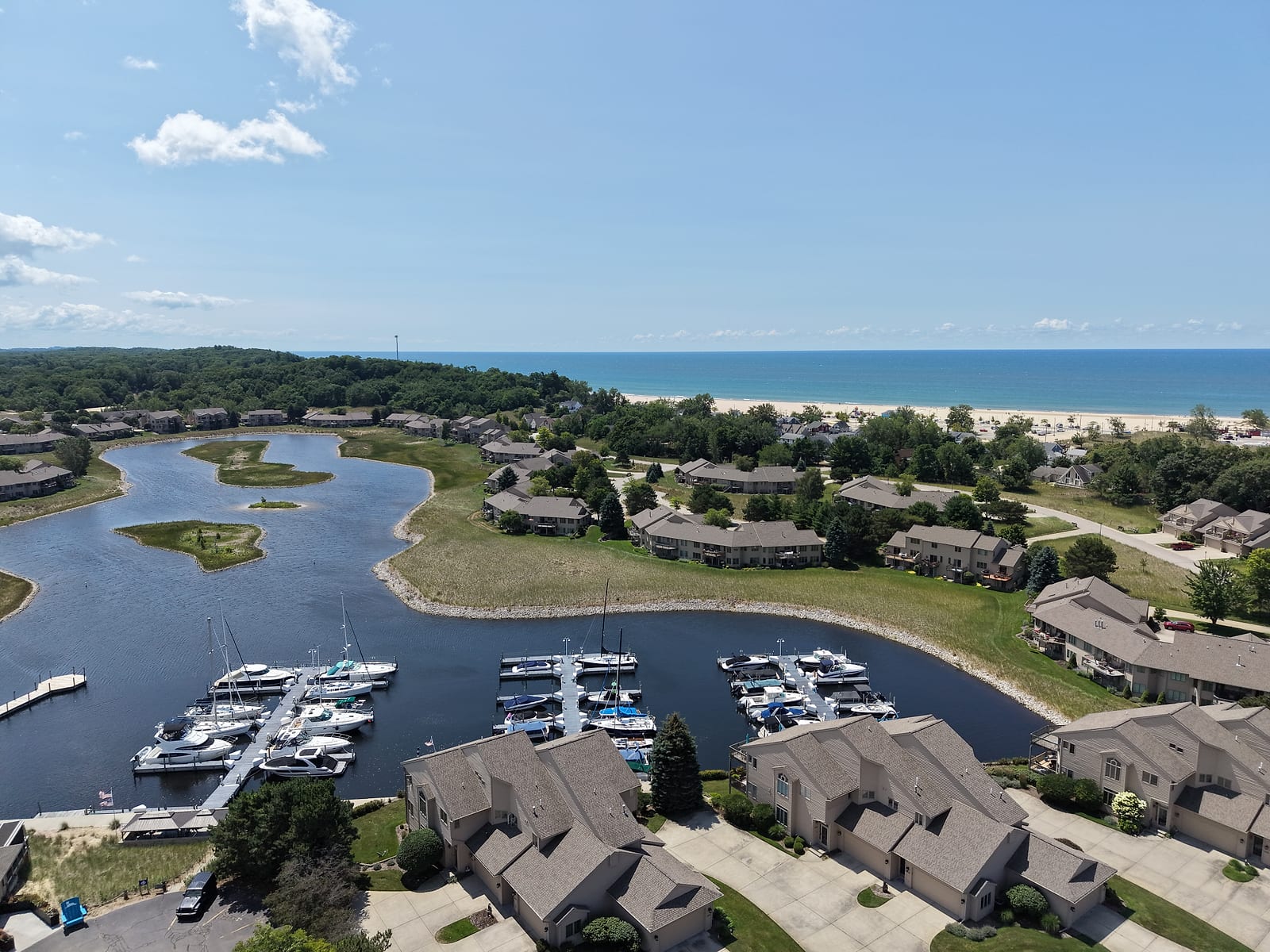
That location is the practical prize. Boaters based farther east on Muskegon Lake cross most of the lake before they reach big water; a Harbour Towne boat starts the day at the channel mouth. The marina even sells that head start to the day-trip crowd: its FAQ says plainly that its launch ramp is public, self-serve at posted daily and seasonal rates. For the rest of the lake's access - the four city ramps, the Snug Harbor state-park launch, and the Hartshorn slips that rent rather than sell - see the Muskegon Lake marinas and boat launches guide.
For a buyer, slip ownership cuts both ways. A deeded or owned slip is a real asset that big-lake boaters pay for - the original 1980s sales brochure pitched exactly that, calling the place a "snug harbor for boaters and those who yearn for a secure home at the water's edge." It also means one more set of documents: whether a slip conveys with a unit, what the marina association charges, and what its rules allow are separate questions from the condo association's own paperwork.
Water levels add a layer that only the low years teach, and I saw it myself. During the last long stretch of low water on Lake Michigan, I looked at a slip here that had sanded in - shallow enough that it could not take a boat at all. It was one slip, and I was not surveying the others, so treat this as a lesson rather than a survey: a slip is a fixed hole in the ground, and the lake that fills it moves in cycles measured in years. I even ran the buyer's math at the time - a slip nobody can use is priced accordingly, and the water did eventually come back - but whichever side of that bet you would take, take it with open eyes. Before buying any slip, owned or deeded, ask what its depth was at the last low water, not just what it measures today.
Living at Harbour Towne
The 190 units come in 25 building footprints, on two or three levels, running from roughly 1,000 to 4,000 square feet - every one with a private entrance and an attached garage, which is not a given in waterfront condo living. Depending on the building, the view is the marina, the interior lagoons, Muskegon Lake, the channel, or the dunes. The association's favorite line about the setting is hard to argue with: sunrise over Muskegon Lake, sunset over Lake Michigan, without moving your chair far.
Buyers should read this community through two sets of documents, because there are two associations doing the controlling: the condominium association for the buildings, grounds, and lagoons, and the marina association for the slips. Everything on the waterfront condo buyer checklist applies twice here - reserves, assessment history, insurance claims, and exactly what conveys.
One records tip: the community spells its name Harbour Towne, and nearly all of the county's tax descriptions agree - but a few of the county's own entries render it Harbor Towne, so a title or parcel search that comes up empty under one spelling is worth running again under the other.
On the condo side, the association's own pages describe a setup that checks the boxes I tell buyers to look for: a volunteer board of five to seven co-owners serving three-year terms, a professional management company handling the finances and maintenance coordination, and a reserve fund managed against a reserve study prepared by an outside firm - the exact document the checklist says to request, named in public before you even ask. The board also meets in the most Muskegon place imaginable: as of 2026, second Wednesdays at the USS Silversides submarine museum on Bluff Street. Ownership here has the fine-grained quirks every association has - decks are the co-owner's job to maintain and replace, with board approval required before the work starts, while the association handles exterior electrical right down to the garage light bulbs. Read the rules summary before you offer, not after.
Renting a unit runs through two rulebooks, and the association's is stricter than most people assume. Rentals are allowed, with every proposed lease submitted to the board - but the association's published rules also say no unit may be leased for less than six months or more than one year without the board's prior permission. Under the default rule, a weekend vacation rental is simply not on the menu. The city's short-term rental licensing is the second rulebook, and this peninsula sits in the Beachwood/Bluffton corner of town, the overlay zone the city listed as full and waitlist-only as of mid-2026. Anyone pricing a Harbour Towne unit on projected Airbnb income should read the Muskegon short-term rental rules guide first, then verify the current association documents and the parcel's zone with the city.
One more thing I can tell you first-hand, because I have been in these condos when it happens: summer nights on this peninsula come with a soundtrack. The marina restaurant has a long habit of booking live bands: that was Dockers Fish House for years, and the spot reopened as BoDocks Marina Bar & Grill in May 2026 after a year of renovation. On the right night the music from The Deck at the beach carries across the water too; the same local restaurant family, Harris Hospitality, runs both venues. Plenty of residents count that as part of the charm - dinner music without a reservation. In the buildings closest to the marina, it lands differently, especially with the windows open. The venues are part of what makes the peninsula lively, so the question is fit, and there is only one way to test it: stand in the specific unit you are considering on a warm weekend evening, and listen before you offer.
The fog horn is its own sound. The Coast Guard runs the channel's fog signal by radio these days - boats coming through key it on over the VHF, and it sounds until it times out - so when fog settles over the big water on a busy day, you will still hear that horn off and on for as long as the fog does. It is part of lake life this close to the channel.
The other tradeoff you hear about from people who live out here is the drive. The peninsula is the end of the line, and every trip toward downtown - dinner, groceries, the workday - starts with the same slow, winding run along the lakeshore, slower still in beach season. It is worth driving that stretch yourself at the hours you would actually be driving it. Most residents make their peace with the trip as the toll for living where the land runs out; the happiest ones are the ones who counted it before they bought.
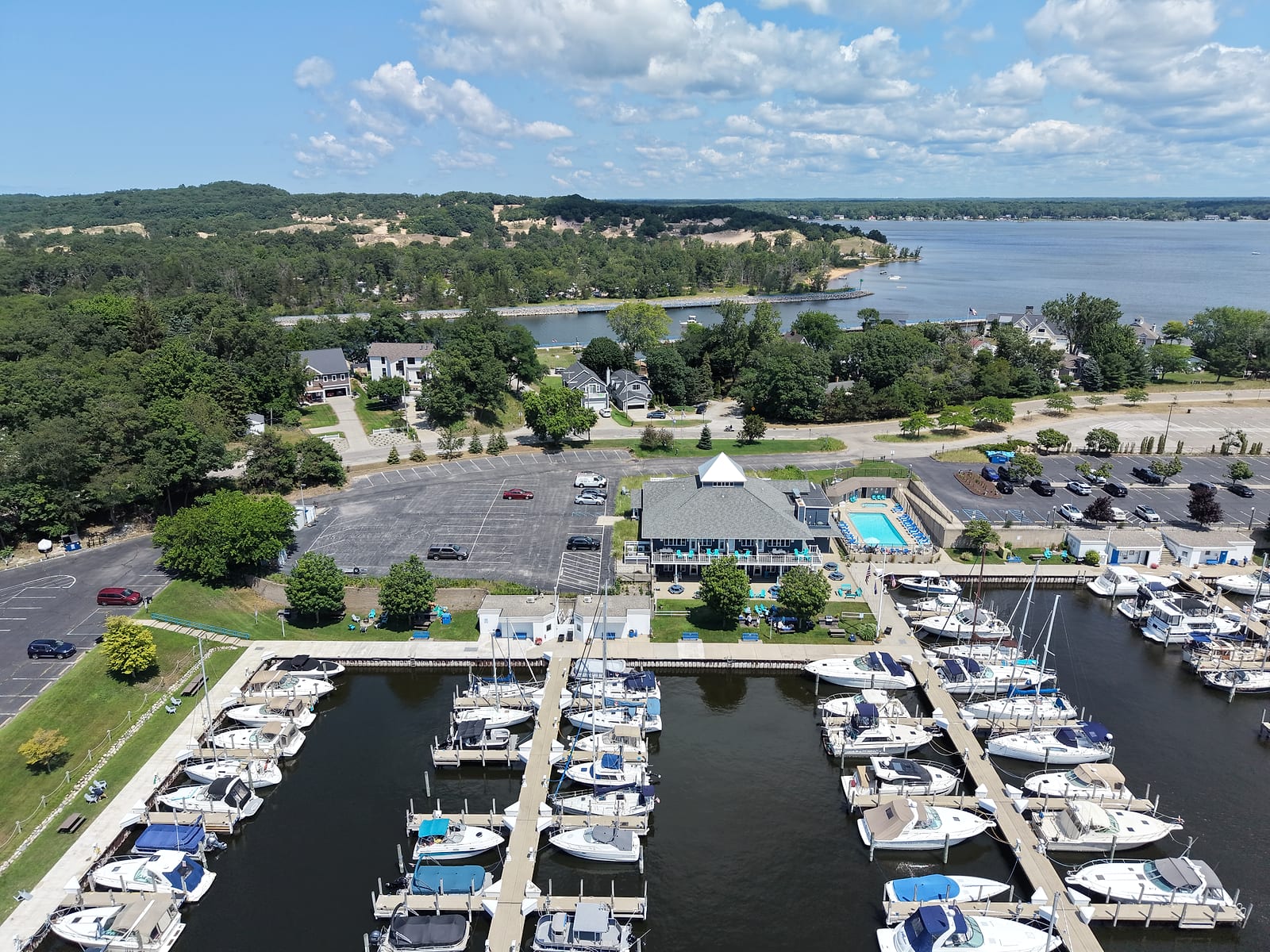
Overnight guests have an answer inside the community too. The pyramid-roofed building at the marina's edge is The Pidge Inn, a small boutique hotel at 3425 Fulton Avenue whose nine rooms, lofts, and suites look over the slips, with a seasonal pool and hot tub alongside. Michigan Blue magazine tells the backstory: a 2019 conversion of the former Harbour Towne Yacht Club building. For owners it solves the guest-bed problem every lake condo eventually meets, and for shoppers it is the rare chance to sleep inside the neighborhood before buying into it - the inn's own pitch is that no Muskegon hotel sits closer to Lake Michigan.
And know that the community is likely to grow. In late 2024, the City Commission approved a PUD amendment allowing six fourplexes and two duplexes - 28 more units. It took the usual two votes: the first reading passed 5-2 on October 22, and final approval came at the November 12 second reading, 4-2 with one member absent. The conditions attached include a fire-department turnaround at Channel View Point, an additional hydrant, a stormwater permit, a landscaping plan, and sidewalks through the Harbour Towne Circles within two years of construction starting. If nearby construction would bother you, or new inventory changes your resale math, ask where those buildings are planned before you buy. Approved does not mean built; confirm the current status with the city or on the ground.
Harbour Towne Beach: The Public Corner of a Private Peninsula
The end of the peninsula belongs to everyone. Harbour Towne Beach is a City of Muskegon park overlooking Muskegon Lake and the channel out to Lake Michigan - a favorite local spot for watching the boat parade in and out of the big lake. The city equips it with a fire pit, a rescue board, seasonal water-safety equipment between Memorial Day and Labor Day, parking, and a portable restroom.
In the city's park directory this park is listed as Harbour Towne Beach Charter, and the last word is a designation with teeth. A chapter added to Muskegon's city charter in 1998 lets the City Commission declare city-owned land a Charter Park, a status the charter makes irrevocable once granted. After that, the city cannot sell, mortgage, or transfer the land unless a majority of the electors voting at a city election approve it.
The walking radius may be the best daily amenity of all, and the association's own pages make the point: all three waters are reachable on foot from here. One direction is Lake Michigan sand along Pere Marquette's public stretch. Another is the channel wall, where the walk runs past the USS Silversides - the same WWII submarine museum where, fittingly, the condo board holds its meetings. And the Muskegon Lake beach sits right at the end of the street. Three different waterfronts in one morning walk, without touching the car.
The practical note for visitors and buyers alike: the beach is public, while the condominiums and most of the marina around it are private, and the boundary is easier to miss than you would expect. Visitors should respect the association property that surrounds the park; buyers should understand that a public park with summer traffic sits at the end of their street. That is the deal this peninsula offers.
A peninsula between two lakes and a shipping channel is a spectacular place to live and a demanding place to own. Wind exposure, shoreline behavior, association-controlled seawalls, and the water history of a specific building are exactly the details that never appear in a listing. The Muskegon waterfront flooding and hidden risks guide shows you how to check what the records and the marketing leave out.
Common Questions
Where is Harbour Towne in Muskegon?
In Bluffton, out at its Lake Michigan end - the peninsula whose north edge doubles as the Muskegon channel's south wall. Walk one direction and you reach the channel wall; walk the other and you are on Lake Michigan sand. Muskegon Lake wraps the third side, which is why the community can honestly claim water in every direction.
What is a dockominium?
A boat slip you own the way you would own a condo unit, rather than rent from a marina operator. Harbour Towne Marina was incorporated in 1983 and is structured exactly that way: the slips are individually owned, with a few rented out seasonally by their owners. Owning the slip changes the buying math, so confirm whether a slip conveys with any unit you are considering.
Is Harbour Towne Beach public or private?
The beach at the end of the peninsula is a public City of Muskegon park, open to everyone, and the city outfits it for the summer season - fire pit, rescue board, water-safety gear from late May into early September. The condominiums and most of the marina facilities around it are private. The boundary between the two is not obvious on the ground, so watch for the signage.
Can you rent out a Harbour Towne condo?
Long-term leasing, yes; vacation rentals, not by default. The association allows rentals with the proposed lease submitted to the board, and its published rules say no unit may be leased for less than six months or more than one year without the board's prior permission - which takes ordinary Airbnb-style stays off the table before the city even weighs in. City short-term rental licensing stacks on top as its own hurdle, and the surrounding Beachwood/Bluffton overlay zone showed full, waitlist-only status in mid-2026. Check the association's documents as they stand today and confirm the parcel's zone before counting on rental income; the Muskegon short-term rental rules guide on this site covers the city side in detail.
Are more condos being built at Harbour Towne?
The city approved more in the fall of 2024: a Planned Unit Development amendment for 28 additional units - six fourplexes and two duplexes. The first reading passed the City Commission 5 to 2 on October 22, 2024, and final approval came at the second reading on November 12 by a 4 to 2 vote. The approval came with strings attached, including fire-truck access, hydrant, stormwater, and landscaping requirements, plus sidewalks due within two years of breaking ground. Whether construction has followed is a separate question; check with the city for where it actually stands.
How fast can a Harbour Towne boat reach Lake Michigan?
Minutes. The marina sits just south of the channel that connects Muskegon Lake to Lake Michigan, sheltered by the old dunes, and from a slip here the channel mouth is essentially the front door. Boaters everywhere else on Muskegon Lake measure their run to big water in miles; here it is measured in boat lengths.
Sources
- Harbour Towne Condominium Association: history and construction photographs - the 1983-1992 pre-construction period, the 1993 Lake Darien excavation, and the 1993-94 building sequence (reviewed July 2026)
- Harbour Towne Condominium Association: community description - 190 units, 25 footprints, sizes, entrances, and garages
- Harbour Towne Condominium Association: management and governing documents and association FAQs - board structure and terms, reserve-study-based reserve management, meeting schedule, rental lease review, and the deck and exterior-electrical responsibility split (reviewed July 2026)
- Harbour Towne Condominium Association: rules and regulations summary - the lease-term rule: no unit leased for less than six months or more than one year without prior board permission (reviewed July 2026)
- Harbour Towne Marina: about and slip information - 1983 incorporation, dockominium structure, slip counts, and location
- City of Muskegon Commission packet, October 22, 2024 - the June 12, 1990 PUD approval, the 250-unit maximum, 190 units built, and the 2002 amendment; the October 22 minutes recording the 5-2 first-reading vote on the 28 additional units; and the November 12, 2024 minutes recording the 4-2 second-reading final approval with conditions
- City of Muskegon: Harbour Towne Beach - public park status and amenities
- City of Muskegon Charter: Chapter XX, Charter Park Lands - the Charter Park rules: designation by City Commission resolution, irrevocable once made, and no sale, mortgage, or transfer without the approval of a majority of electors voting at a city election (chapter added August 4, 1998; reviewed July 2026)
- Bluffton neighborhood history: Pigeon Hill - the dune's size and 1907 measurement, the passenger pigeons, the 1925 mining announcement, the 1936 Sand Products conveyor, the 1967 end of mining, and the 1992 ownership change
- United States Coast Guard Light List, Volume VII (Great Lakes) - the Muskegon channel fog signal operates by mariners keying VHF-FM channel 83A (reviewed July 2026)
The Agent on the Listing Works for the Seller
Every listing, yard sign, and community page carries a contact, and that person represents the seller - a listing agent under contract to the seller, or at a new development the developer's own sales staff. Anything you share before you have representation of your own - budget, timeline, how much you want the unit - can serve the seller's side of the table.
Buyers do better with their own agent, from a different brokerage, whose only loyalty in the deal runs to them. Who pays that agent is negotiated and put in writing before you tour, and a seller can agree to cover it in the purchase agreement. How agency works in Michigan, and why the stakes are higher on a condo purchase, is covered in the buyer checklist.
How agency works in MichiganRelated Guides
Muskegon Waterfront Condos & HOA Guide
How Harbour Towne compares with the area's other condo communities, and what an association actually controls.
Read the guideWaterfront Condo Buyer Checklist
The documents to request before buying here - and at Harbour Towne, there are two associations' worth.
Read the checklist