Terrace Point Landing: Houses That Are Legally Condos on Downtown Muskegon's Shore
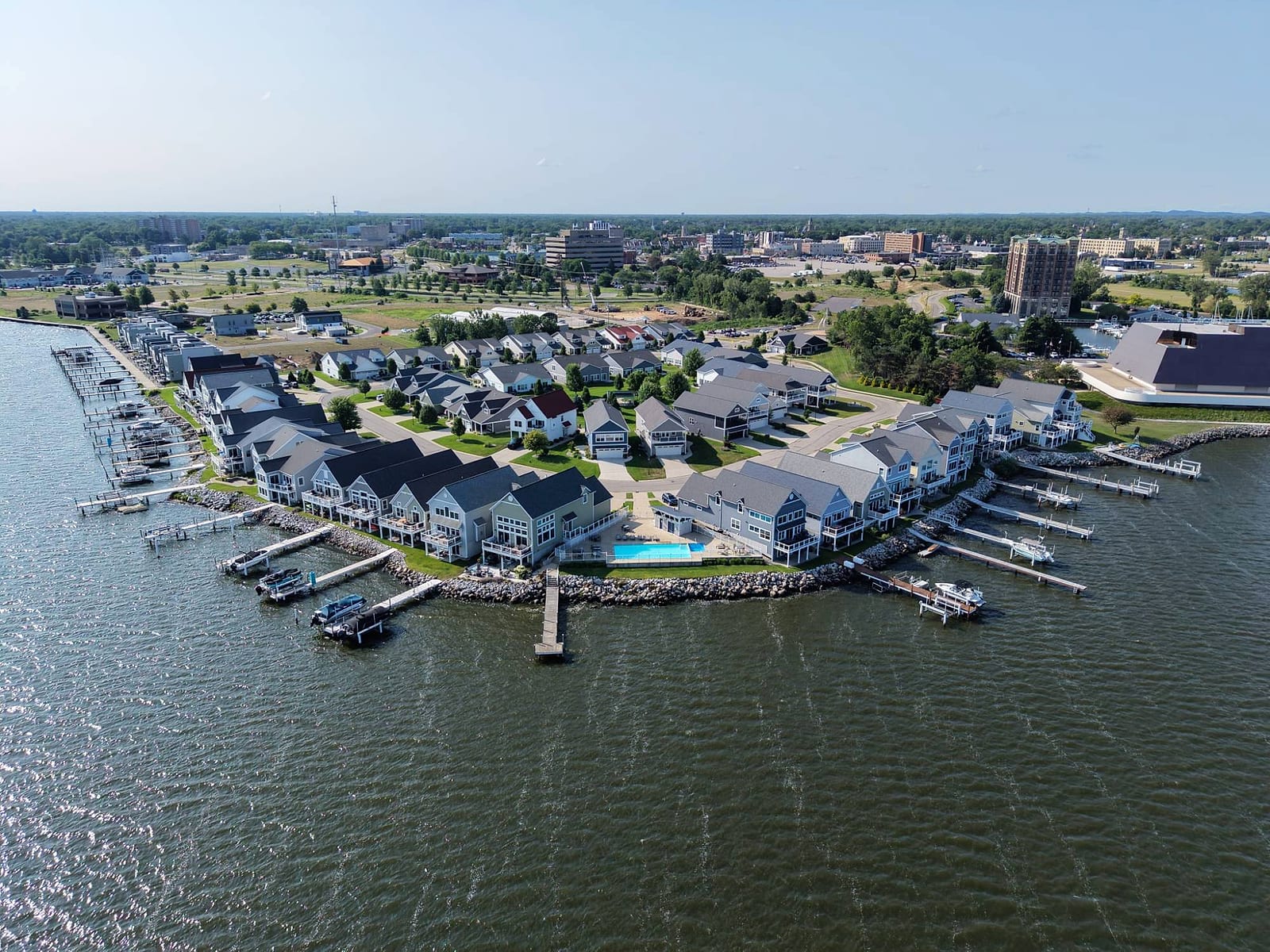
Terrace Point Landing is the neighborhood of front porches at the end of Terrace Point Road, on the downtown side of Muskegon Lake, built on former Continental Motors ground that sat contaminated and vacant for decades. Seventy residences were approved in 2013 and platted in stages through 2019, from waterfront houses with private docks to paired condos on curving streets. Every one of them is legally a condominium unit - a detail that shapes what you buy, which of the neighborhood's two associations you join, and which documents you need to read. The whole story, from the approvals to the tax certificates, is told below; for how Terrace Point Landing compares with the area's other communities, see the waterfront condos guide.
Last reviewed July 2026. Fees, tax certificates, and record details are dated where they appear - verify current figures with the associations, the county, and the city assessor before relying on them.
Quick Facts
- Residences
- Up to 70 authorized; 69 unit parcels on the July 2026 county roll across two condominium projects
- Associations
- Two Michigan nonprofits - site condominium (2015) and condominium (2022 entity); both active and in good standing as of July 2026
- Waterfront
- Muskegon Lake's downtown shore; waterfront units own adjacent bottomlands for private docks
- Built
- Roughly 2015 to 2025, in phases; the last sites filled in through the mid-2020s
- Taxes
- Neighborhood Enterprise Zone; 12-year certificates on many homes, city-approved 2015 to 2025
- Schools
- Muskegon Public Schools, per county records
From Engine Plant to Front Porches
The land tells you why this neighborhood took decades to happen. The city's brownfield plan identifies the site as part of the former Continental Motors property - the manufacturer whose lakefront operations were once Muskegon's largest employer, building engines that powered Sherman tanks during the Second World War. Environmental assessments in 2009 found soil and groundwater contamination above Michigan's residential cleanup criteria, including cadmium, lead, chromium, nickel, and cyanide, enough to classify the property as a regulated facility under state law. The city had approved a planned unit development for the Terrace Point peninsula back in 1989 covering a hotel, a marina, a restaurant, public waterfront access, and condos; by the city's own account, the condos were the only piece that never got built.
The plan that finally worked came in 2013, when developer Jon Rooks petitioned through Terrace Point Landing, LLC to swap the unbuilt condo concept for a neighborhood of up to 70 site condominiums on roughly 11 acres of vacant shoreline. The city commission approved it unanimously that February, and a brownfield plan the same spring laid out the environmental work: baseline assessments, removal of impacted soil encountered during construction, a foot of clean fill capping impacted soils in the green spaces, seawall work, and new streets and utilities, at about $2 million of an estimated $12 million project. Rooks later put the fill in plainer terms in a 2021 WZZM interview: 2,800 tandem-axle dump trucks of clean sand, on ground he said most people thought he was "a little crazy" to take on.
Sales started slow - three lots the first year, by the developer's own telling - and then the neighborhood found its footing. A model home opened in August 2015, and the city accepted Terrace Point Circle and the Terrace Point Drive extension as public streets that same spring. By late 2021, news coverage had the neighborhood down to its final building site, with the finished mix described as 28 waterfront homes, 8 interior homes, and 34 condominiums. Even then the last houses were still coming: one of the final sites sold as a vacant lot in late 2024, and in April 2025 the city approved a tax certificate for the new home going up on it. What reads as a quick success story in a listing was actually a twelve-year grind through contamination, infrastructure, and a housing market that had never been asked to buy new construction on downtown Muskegon's shoreline. The Muskegon waterfront transformation guide tells the wider story this neighborhood belongs to.
One Neighborhood, Two Condominiums
Here is the part of the record every buyer should understand before falling for a floor plan. Terrace Point Landing is legally two condominium projects. The original master deed, recorded in June 2015, created the Terrace Point Landing Site Condominium - county Condominium Subdivision Plan No. 194 - covering the whole 70-unit layout. In a site condominium, the "unit" you own is the house and its site under a shared master deed; it looks like a subdivision and functions like a condominium, which is why detached houses here come with an association, bylaws, and architectural control.
In 2017, with the interior lots moving slowly, the developer won city approval to combine 38 interior lots into 19 larger sites carrying one- or two-unit homes. The following September, a third amendment withdrew the unsold interior units from the site condominium, and a second master deed established Terrace Point Landing Condominiums - Plan No. 206 - on that withdrawn land, growing by amendment to 34 units by early 2019. The county roll today shows 35 site-condominium parcels and 34 condominium parcels.
Two projects means two associations, and the state registry backs that up: the Terrace Point Landing Site Condominium Association, incorporated in 2015, and the Terrace Point Landing Condominium Association, whose current entity dates to 2022. An earlier association company formed in 2017 was dissolved by operation of law - which typically follows missed annual filings - and the record does not say more than that. Both are active and in good standing as of July 2026, and both list Cornerstone Association Management, based in Holland, as their registered agent. That answers the who-do-I-even-call question that stalls buyers at associations with no web presence - and neither association here keeps one.
The two associations do not operate in separate worlds. A recorded amenities-sharing agreement from 2018 has them owning the pool, clubhouse, open space, and parking amenities together as tenants in common, with costs shared pro rata by unit count. For a buyer the practical meaning is simple: ask which project the address belongs to, get that association's master deed, bylaws, budget, and reserve information, and understand that part of your fee funds amenities co-owned with the association next door. The waterfront condo buyer checklist covers the full document request, and it applies here twice over.
Docks, Bottomlands, and the Pool
The waterfront rules here are unusually clear because they are written into the recorded master deed. A waterfront co-owner may moor a boat on bottomlands the co-owner owns, immediately adjacent to the unit - meaning the lakefront houses control their own frontage and put in private docks, and listings over the years have advertised 60- and 70-foot permanent docks with boat lifts. The bylaws also carry limits worth knowing before you park a big cruiser out front: one vessel per slip without association consent, no boat taller than 20 feet above the waterline moored within 70 feet of the shoreline, docks and boats out by mid-November, and language encouraging neighbors to share docks and lifts. Those are the recorded 2015 rules; amendments and association policies can move details, so confirm the current version.
Interior homes and the attached condominiums work differently: listings describe a shared association dock with limited daily use, alongside the lakefront pool, hot tub, and bathhouse with community showers. Ask about one amenity from the original plan rather than assuming it: the 2013 approval called for a natural-sand beach north of the pool, subject to state permits, and current listings sell the pool, hot tub, and dock without mentioning a beach. Whether a maintained swimming beach exists today is a walk-the-grounds question for your visit.
For boats that outgrow a private dock or a shared one, Terrace Point Marina operates next door on the same peninsula, run as part of the Shoreline Inn property, with seasonal memberships and transient dockage in slips its own site lists at 35, 40, and 50 feet. No public document I can find promises Terrace Point Landing residents any preference there, so treat the marina as a convenient neighbor with its own waiting lists and prices, and confirm availability with the marina directly. If you are weighing communities by their slip arrangements, it is worth reading how differently Harbour Towne handles this - slips there are owned outright as dockominium property. And put that guide's low-water question to every association here: what did this shoreline look like the last time Great Lakes water levels dropped?
One more design detail from the city file that buyers of interior homes will appreciate: the site was deliberately graded higher toward the back of the neighborhood so that lots away from the water would still catch lake views. The same approval required every home to sit above the lake's ordinary high-water elevation of 584 feet. Views vary lot by lot and floor by floor all the same - stand in the specific house and look.
Living at Terrace Point Landing
What draws buyers here is the pairing of open water off the front porch with downtown within walking distance. The peninsula itself supplies dinner and a nightcap - The Lake House restaurant sits on the water a few steps away, next to the Shoreline Inn - and Western Avenue's restaurants, breweries, farmers market, and event calendar are a walk beyond that, no car involved. Waterfront homes face north across the lake toward North Muskegon and Muskegon State Park, with the channel to Lake Michigan a few miles west by boat. The developer's 2021 estimate put the finished neighborhood at about 200 residents, a meaningful addition to downtown's year-round population.
The setting comes with texture a listing would not mention. This is a working peninsula shared with a hotel, a marina, a restaurant, and an office building, so summer brings marina traffic, hotel guests, and restaurant crowds to the same streets residents live on. That is the price of walkability, and one you should experience on a busy July evening before you decide how you feel about it. The neighborhood's own streets, accepted by the city in 2015, curve tightly enough that the city waived its normal subdivision geometry standards on its engineers' recommendation - traffic-calming design, per the record. And the streets are public: city-owned and city-maintained, a detail that stands out in a region where plenty of condo communities carry private drives on the association's budget.
As for the houses themselves, listings show the range: compact two-bedroom waterfront ranches, four-bedroom attached homes around 2,000 square feet, and larger custom waterfront builds, most dating from 2016 through the mid-2020s. Listings credit Dave Dusendang Custom Homes with a number of the builds, and the original approval required designs to pass through architectural standards prepared by Sears Architects, which is why the neighborhood reads as one place rather than a catalog of unrelated houses.
The NEZ Tax Story
Terrace Point Landing sits inside a Neighborhood Enterprise Zone the city created for it in 2013, and that has been part of the sales pitch here from the first model home. City commission approvals from 2015 through 2025 granted individual homes 12-year NEZ certificates - the early resolutions spell out taxation at 50 percent of the statewide average rate for the certificate's term, on homes that are the owner's primary residence. Recent listings advertise the benefit on specific homes as running through 2032.
The honest caveats: the certificate belongs to the property, the remaining term varies with when each home was certified, the benefit assumes primary-residence status, and when it expires the taxes step up to normal. Before you count NEZ savings in a purchase decision, have the City of Muskegon assessor confirm the certificate, its end date, and what the post-NEZ tax bill looks like. For the wider picture of how millage and taxable value work across the area's waterfront, see the Muskegon waterfront property tax comparison.
What It Costs and What to Ask
Advertised association fees have risen over the neighborhood's life: listings quoted $128 to $130 a month in 2021, $200 in one 2024 sale, and $250 across several 2024 and 2025 sales, generally covering snow removal and lawn care, with one condo listing adding sewer and trash to the list. The spread between figures from the same era may simply be the two associations charging differently, but the public record does not say, which is itself the point: a listing's fee line tells you what one seller's agent typed into a form. The current budget, the reserve funding, the shared-amenities cost split, and any planned special assessment live in association documents you have every right to request before an offer.
Resales have come up here regularly in recent years, but with waterfront ranches, interior houses, and attached condos in one neighborhood, no sale sets the value of the next. Add the NEZ wrinkle, which can make two similar homes carry very different tax bills depending on certificate dates, and this is a place to price carefully rather than by neighborhood reputation.
A neighborhood this photogenic was still built on capped industrial ground beside big water, and the gap between the brochure and the record is where waterfront purchases go wrong: flood elevations, shoreline and seawall responsibilities, what a brownfield cap does and does not promise, two associations' reserves, and tax bills that change when certificates expire. The Muskegon waterfront flooding and hidden risks guide walks the brochure-to-record gap one check at a time.
Common Questions
Where is Terrace Point Landing in Muskegon?
At the end of Terrace Point Road on the downtown side of Muskegon Lake, sharing a small peninsula with the Shoreline Inn hotel, Terrace Point Marina, The Lake House restaurant, and the office building at the peninsula's entrance. Downtown Muskegon's Western Avenue restaurants and events are a walk away rather than a drive. The homes sit in the Muskegon school district, and the streets are city streets, publicly owned and maintained.
Are Terrace Point Landing homes houses or condos?
Both, and legally they are all condominium units. The detached houses were created as a site condominium - a legal structure where what you buy is recorded as a unit rather than a conventional platted lot, even though it lives like ordinary homeownership. The paired and attached homes belong to a second, separate condominium project recorded in 2018. Each project has its own master deed, bylaws, and co-owners association, so two neighbors on the same street can answer to different documents. Which project a specific address belongs to is a question for the seller and the county record, and it decides which rulebook you are buying into.
How many homes are in Terrace Point Landing?
The 2013 plan authorized up to 70 residences, and news coverage of the build-out broke that down as 28 homes on the water, 8 interior houses, and 34 condominiums. The county tax roll I pulled in July 2026 shows 69 unit parcels across the two condominium projects, one of them a merged pair of two original units. Construction started around 2015 and ran roughly a decade; the city approved a tax certificate for a brand-new home on one of the last sites in April 2025.
Do Terrace Point Landing homes come with boat docks or slips?
Which kind of unit you buy decides this. For the lakefront houses, the recorded bylaws tie mooring rights to bottomlands the waterfront owner holds along that unit's frontage, which is why those homes carry their own docks; the dock dimensions marketed in listings run to 60 and 70 feet, boat lifts included. Interior homes and the attached condominiums rely on the shared association dock that listings describe, with limited daily use. And Terrace Point Marina operates right next door with seasonal slips the marina's site lists at 35, 40, and 50 feet; nothing in the public record gives residents a claim on those, so any slip there is an arrangement you make with the marina yourself.
What does the Terrace Point Landing association fee cover?
Snow removal and lawn care are the services listings name most often, and exactly one condo listing has stretched it to include sewer and trash. The advertised amount has roughly doubled over the neighborhood's life - from around $130 a month on 2021 sales to $250 on sales in 2024 and 2025. The pool, hot tub, and common grounds are shared between the two associations under a recorded cost-sharing agreement, so pin down which of the two the unit answers to and read its current budget rather than pricing off a listing line.
What is the NEZ tax break on Terrace Point Landing homes?
The neighborhood sits in a Neighborhood Enterprise Zone the city created in 2013, and many of its homes hold individual 12-year NEZ certificates approved by the city commission at various points between 2015 and 2025. Under a certificate the home's structure is taxed at half the statewide average rate, and the program is aimed at primary residences. Listings in recent years have advertised the benefit as good through 2032, but the certificate, its remaining term, and what the taxes become when it expires are specific to each property - verify all three with the City of Muskegon assessor before you count the savings.
Can you rent out a Terrace Point Landing home?
Plan on verifying two layers before buying with rental income in mind. The City of Muskegon licenses short-term rentals and limits how many licenses its zones can hold, so whether a new registration is even available is a city question. On top of that, each of the two associations has bylaws recorded with its master deed, and association documents can restrict leasing in ways no public website shows. Get the city's answer and the association's rental rules in writing first.
Sources
- City of Muskegon Commission packet, February 26, 2013 - the PUD amendment approving up to 70 site condominiums, the 1989 Terrace Point PUD history, and the staff report's grading, shoreline, beach, and height details
- Terrace Point Landing Brownfield Plan Amendment, adopted May 14, 2013 - the former Continental Motors property identification, the 2009 environmental findings, the eligible cleanup and infrastructure activities, and the project investment estimates
- City Commission minutes, May 2015 - acceptance of Terrace Point Circle and the Terrace Point Drive extension as public streets; Planning Commission packet, September 2017 - the interior-lot amendment allowing one- and two-unit homes; City Commission minutes, April 2025 - the newest 12-year NEZ certificate
- Recorded master deeds via Muskegon County: Terrace Point Landing Site Condominium, Plan No. 194 (June 2015, with the bottomlands mooring and dock bylaws) and Terrace Point Landing Condominiums, Plan No. 206 (September 2018); the 2018 amenities-sharing agreement is recorded with the county Register of Deeds (index reviewed July 2026)
- Muskegon County property records - the 69 unit parcels, the two condominium plans, school district, and street right-of-way conveyance (reviewed July 2026)
- Michigan LARA business registry - Terrace Point Landing, LLC (2012, resident agent Jonathan L. Rooks) and both co-owners associations, with Cornerstone Association Management as registered agent (reviewed July 17, 2026)
- WZZM 13, August 31, 2021 - the build-out story, the Rooks quotes on contamination work and the 2,800 truckloads of sand, and the 200-resident estimate; unit mix and completion per contemporaneous news coverage and the Muskegon Lakeshore Chamber directory
- Shoreline Inn & Conference Center - Terrace Point Marina slip sizes and seasonal membership information (as of July 2026)
- Fees, amenities, dock and lift details, builder credits, home sizes, and NEZ-through-2032 claims are attributed to current and past listings for Terrace Point Circle and Terrace Point Drive homes, 2021 through 2026 (reviewed July 2026) and marked as such in the text; listing claims change, so verify against the associations' own documents
The Agent on the Listing Works for the Seller
Every listing, yard sign, and community page carries a contact, and that person represents the seller - a listing agent under contract to the seller, or at a new development the developer's own sales staff. Anything you share before you have representation of your own - budget, timeline, how much you want the unit - can serve the seller's side of the table.
Buyers do better with their own agent, from a different brokerage, whose only loyalty in the deal runs to them. Who pays that agent is negotiated and put in writing before you tour, and a seller can agree to cover it in the purchase agreement. How agency works in Michigan, and why the stakes are higher on a condo purchase, is covered in the buyer checklist.
How agency works in MichiganRelated Guides
Muskegon Waterfront Condos & HOA Guide
How Terrace Point Landing compares with the area's other condo communities, and what an association actually controls.
Read the guideMuskegon Lake Living Guide
The lake at the end of these docks: the channel to Lake Michigan, the restaurants you can boat to, and what living on this water is like.
Read the guide